The United States, Israel and Iran are now in their eighth week of conflict.
The fragile, two-week ceasefire, which is set to expire on Wednesday unless the U.S. and Iran reach a nuclear deal before then or both sides agree to extend it, remains in limbo.
President Donald Trump, who has vacillated between making optimistic predictions about diplomacy and belligerent threats to restart the war, says his negotiating team will be on the ground in Islamabad, Pakistan, on Monday evening to try to make a deal.
So far, the Iranians have not publicly agreed to this second in-person meeting.
A White House official told ABC News that Vice President JD Vance will attend negotiations in Islamabad alongside Special Envoy Steve Witkoff and the president’s son-in-law, Jared Kushner.
Ahead of the potential meeting, the key terms of the ceasefire have fallen apart.
Rather than opening the Strait of Hormuz, the critical commercial waterway that before the war carried 20% of the world’s oil, both sides have sought to assert more control over the area.
Iranian forces have once again blocked all commercial vessels from transiting, and the U.S. continues to enforce a military blockade of all ships leaving or entering all Iranian ports. On Saturday, Iranian forces fired on commercial vessels in the Strait, which the president later said was a violation of the ceasefire.

Chairman of the Joint Chiefs of Staff General Dan Caine displays a map showing the blockade line in the Strait of Hormuz during a briefing on the Iran war, at the Pentagon in Washington, April 16, 2026.
Saul Loeb/AFP via Getty Images
On social media Sunday morning, President Trump said the U.S. is offering a “reasonable DEAL,” and threatened that if the Iranians don’t sign it, “the United States is going to knock out every single Power Plant, and every single Bridge, in Iran. NO MORE MR. NICE GUY!”
In the hours before extending the last deadline for a nuclear deal just under two weeks ago, Trump threatened “an entire civilization will die” if the Iranians did not comply.
The president made more threats in an interview with Fox News on Sunday. “If the deal isn’t done, the deal that we made, then I’m going to take out their bridges and their power plants,” Trump said. “If they don’t sign this thing, the whole country is going to get blown up.”
“We’re preparing to hit them harder than any country has ever been hit before because you cannot let them have a nuclear weapon,” he continued.
U.S. Ambassador to the United Nations Mike Waltz defended the president’s latest threats, telling “This Week” co-anchor Jonathan Karl that Iranian infrastructure could be taken out “relatively easily” and that doing so would be “lawful.”
Such attacks would not be considered a war crime because Iran’s infrastructure has dual military and civilian use, Waltz said, citing World War II as a precedent.
“And if you go back in the history of warfare, go all the way back to World War II, of course, we bombed and took down bridges, other infrastructure, power plants that, yes, could be used for civilian, but also are used to manufacture drones and missiles,” Waltz said
Tensions grew even higher Sunday after Trump announced the U.S. Navy seized an Iranian-flagged cargo ship in the Gulf of Oman after it attempted to evade the blockade.

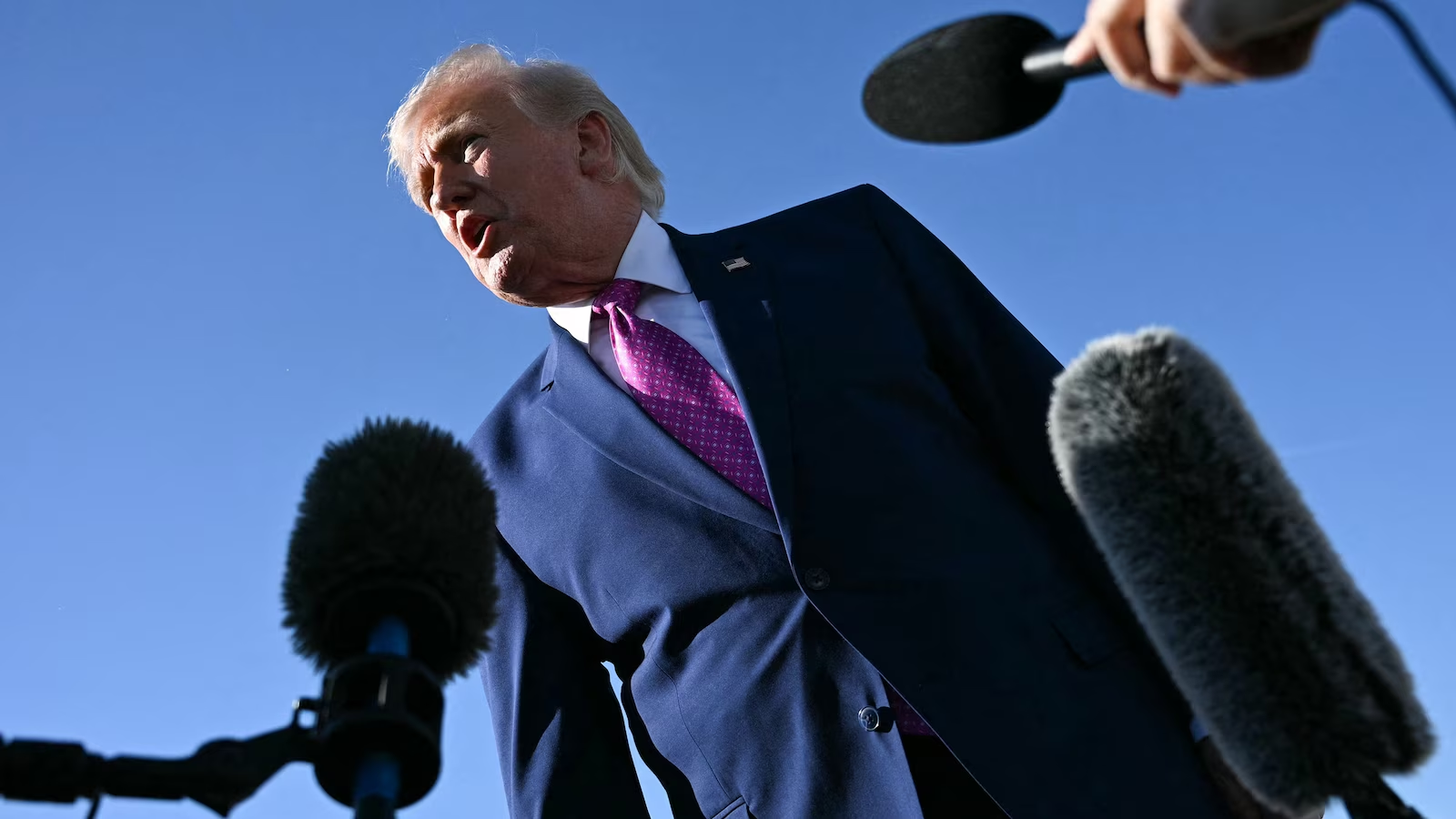
President Donald Trump speaks to the media, before boarding Air Force One on his way to Virginia, at Joint Base Andrews in Maryland, April 10, 2026.
Jim Watson/AFP via Getty Images
“The Iranian crew refused to listen, so our Navy ship stopped them right in their tracks by blowing a hole in the engineroom,” the president said on his Truth Social platform, adding U.S. Marines have custody of the ship.
U.S. Central Command confirmed the actions in a statement late Sunday and said U.S. Navy sailors aboard the Guided-missile destroyer USS Spruance signaled to the cargo vessel to vacate the engine room before “firing several rounds” that disabled the ship’s propulsion.
According to Iranian state media, Abbas Araghchi, Iran’s foreign minister, told Pakistani mediators that “the threat to Iran’s ports and ships and Washington’s irrational demands are a sign of its lack of seriousness.”
The Iranian Military Headquarters said in a statement to state media that the U.S. has broken the ceasefire and that it would “soon respond and retaliate against this armed piracy by the US military.”

Two U.S. Navy guided-missile destroyers conducted operations in the Strait of Hormuz as U.S. Central Command forces began setting conditions for clearing mines, April 11, 2026.
Sgt. 1st Class Michael Hunnisett/US Navy
As for the terms of any possible deal, negotiators have said very little publicly.
U.S. officials and other sources connected to the talks tell ABC News there’s still no agreement on how long Iran would suspend uranium enrichment or the terms around it, a key sticking point in the talks.
Trump has said Iran would suspend its enrichment indefinitely, but ABC News has reported there are back-and-forth offers, including a recently proposed 20-year suspension that the Iranians rejected.
A U.S. official also said negotiators are discussing multiple ways to address Iran’s highly enriched uranium, including proposals to dilute and remove it from the country. Iran has resisted U.S. offers to dilute the material inside the United States.
There’s also the issue of Iran’s frozen monetary assets. The president has said publicly that Iran will receive no payments in any form, but privately, officials say the issue is being discussed. They said, however, Iran would not reap any financial benefits without first demonstrating compliance with other terms of the deal.
ABC News’ Jonathan Karl also spoke to Trump by phone on Sunday. Asked if he still thinks he will get a peace deal, Trump said, “It’s going to be very good …They are either going to do it, or they are going to have problems. We’ll see what happens.”
ABC News’ Nicholas Kerr, Shannon Kingston and Luis Martinez contributed to this report.