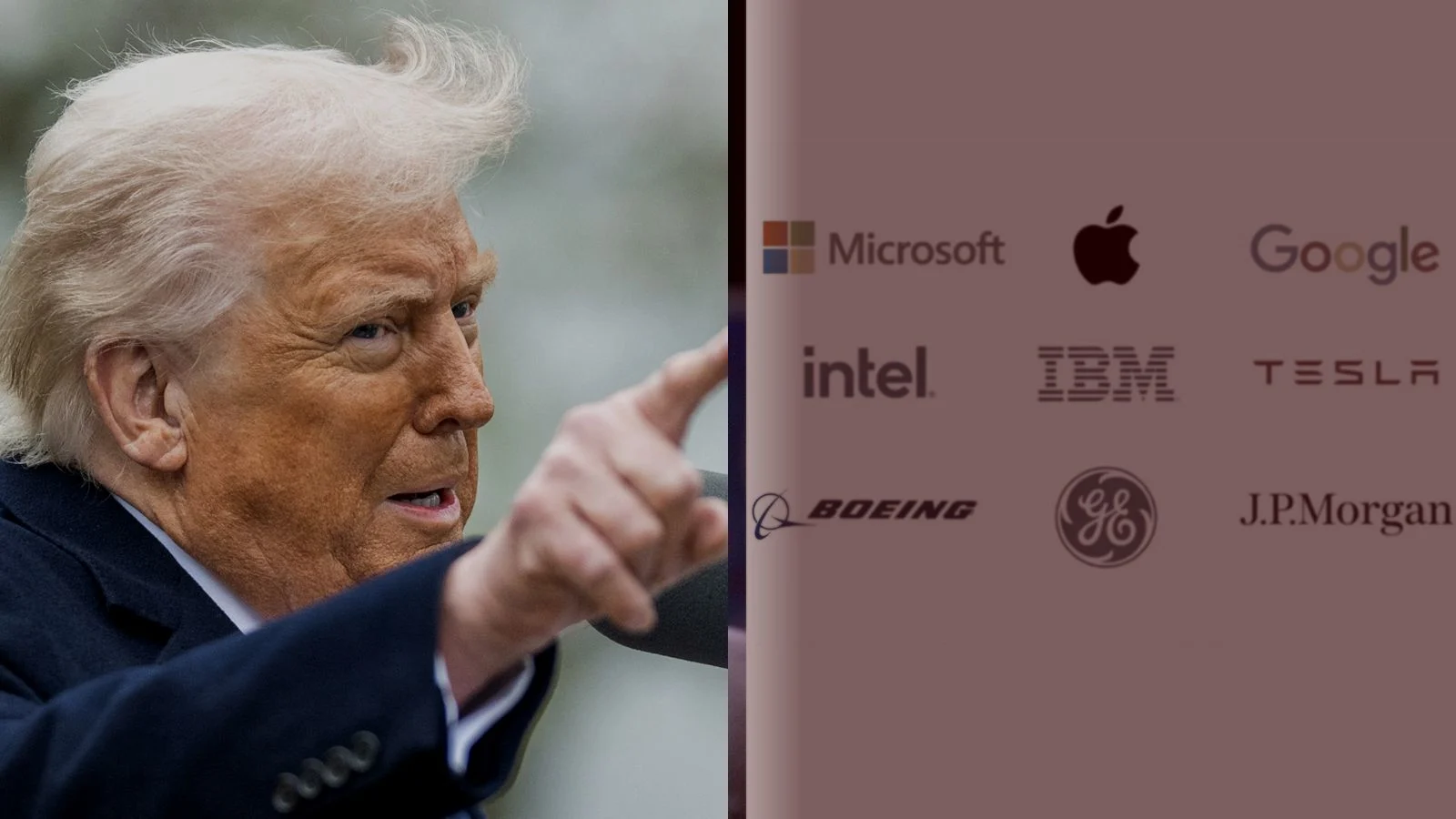
Trump told allies to go “TAKE” the Strait of Hormuz. Spain and Italy had already refused to support the war. The president’s response was to tell Europe to buy American fuel or fend for itself. Hours later, Iran’s Revolutionary Guards named 18 U.S. companies operating in the region and threatened action starting April 1.
The list included Microsoft, Google, Apple, Intel, IBM, Tesla, Boeing, General Electric, and J.P. Morgan. Not abstract Western interests. Recognizable American corporate names spanning technology, defense, finance, and industrial power. Iran was not signaling at a sector. It was signaling to the economy that Americans see when they check their retirement accounts.

The War Just Moved From Sea Lanes to Balance Sheets
The first round of fallout from Trump’s Hormuz posture was diplomatic. Spain closed its airspace. Italy denied base access. Allies pushed back. That was a coalition problem. This is a different kind of problem. Iran’s threat moves the cost of the war from reluctant governments to American companies with regional operations, supply chains, and billions of dollars in Gulf-adjacent exposure.
That matters because it changes who feels the pressure. When allies refuse to cooperate, the political cost stays inside Washington’s foreign policy machinery. When American corporate names land on a threat list from a Revolutionary Guard command, the cost migrates to stock prices, boardrooms, and the voters who own shares in those companies through index funds and 401(k)s.
The Damage Is Not Theoretical

Reuters reported that Big Tech’s planned $635 billion AI spending push for 2026 is already facing an energy-shock test because of the war. Analysts warned that persistently high oil prices could pressure capital spending and hit equity markets. Separately, Reuters reported that U.S. tech stocks are losing their old safe-haven status in the Iran fallout, with the sector down sharply since the war began and the Nasdaq in correction territory.
Gas has pushed past $4 a gallon, according to AP, up from below $3 before the strikes began. The companies on Iran’s list are not being threatened in a vacuum. They are being threatened while their valuations are already under pressure from the same war that put them on the list. The threat did not create the vulnerability. It landed on top of one that was already forming.
April 1 Lands on the Eve of a Date Trump Invented
One year ago, Trump branded April 2, 2025 as “Liberation Day” for his tariff rollout — the centerpiece of his economic nationalism pitch. Iran’s April 1 deadline may or may not be deliberate theater. But the coincidence frames a contradiction that Trump cannot message his way around. A year after he sold economic independence as America’s defining advantage, his war is exposing how dependent American corporate power remains on Gulf stability, allied cooperation, and shipping routes that Washington does not fully control.
Trump sold strength. What this war keeps revealing is exposure.

The Strongman Pitch Is Getting Thinner
There is a hawkish answer to all of this: Iran is threatening American companies because it is under pressure and desperate for leverage. That is probably true. But it does not rescue Trump’s argument. If the war were proving American dominance, the pattern would be allies lining up, markets stabilizing, and Tehran losing room to maneuver. Instead, allies refused. Oil jumped. Corporate names landed on a threat list. The Nasdaq corrected. Gas prices hit levels voters can feel every time they fill the tank.
Trump can still sell escalation as toughness to his base. The “just TAKE it” line will play on Truth Social the way all his lines play. But that line gets thinner once the war stops feeling like a distant test of will and starts showing up in gas prices, portfolio values, and headlines about the companies Americans associate with national power.
Last week, the question was whether Trump’s allies would salute on command. They did not. This week, the question is harder. If Iran can move the war from tankers and sea lanes to a list of 18 American companies, and the markets are already wobbling before the April 1 deadline arrives, then is this still a show of strength — or is it the moment Trump’s version of strength starts getting very expensive for everyone who is not him?