President Donald Trump announced Thursday a plan to impose additional tariffs on countries that provide oil to Cuba, declaring a national security emergency regarding the island nation.
In an executive order, Trump said the “policies, practices, and actions of the Government of Cuba constitute an unusual and extraordinary threat,” with regard to U.S. national security and foreign policy.
The order includes retaliatory tariffs on products sold in the U.S. from “any other country that directly or indirectly sells or otherwise provides any oil to Cuba.”

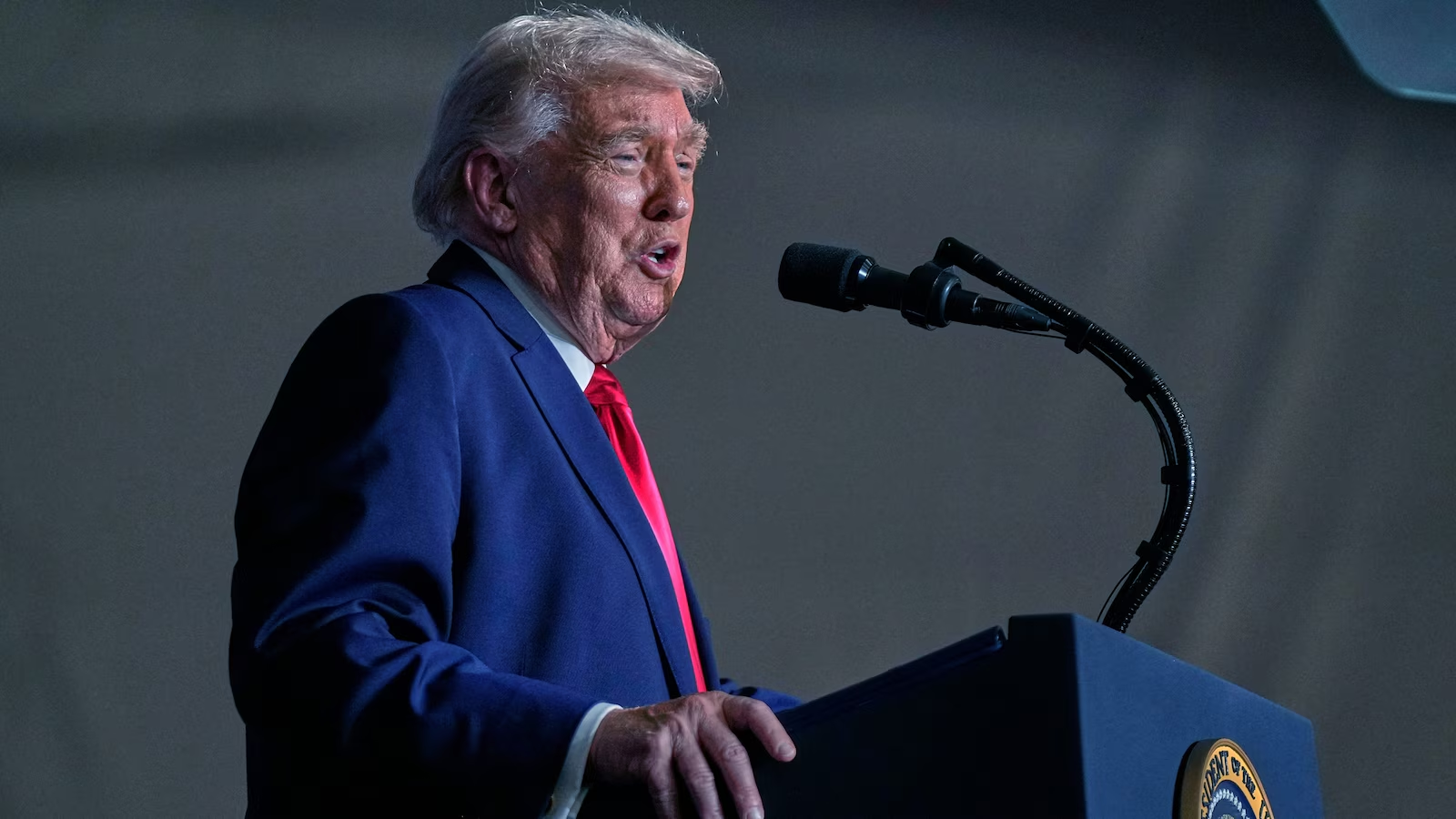
President Donald Trump speaks during an event in Iowa, Jan. 27, 2026.
Mark Schiefelbein/AP
The order does not explicitly say what new tariffs will be imposed. Rather, if a country is found to be selling oil to Cuba, the secretaries of Commerce, State, Treasury and Homeland Security and the U.S. trade representative will determine whether additional tariffs should be imposed on goods coming into the U.S. from those countries. The President will then ultimately determine those tariffs.
Trump’s order stated “the government of Cuba has taken extraordinary actions that harm and threaten the United States,” noting what it called alliances with Russia, China, Iran, Hamas and Hezbollah.
On the red carpet of the Kennedy Center ahead of the premiere of “MELANIA” documentary, Trump told ABC News’ Selina Wang he’s not trying to choke off the country’s economy.
“Cuba is a failing nation, and you have to feel badly for Cuba,” he said. “They’ve treated people very badly. We have a lot of Cuban Americans who really were treated very badly, and they’d probably like to go back. … I think Cuba will not be able to survive.”

Drivers wait in line to refuel at a gas station in Havana on January 28, 2026.
Yamil Lage/AFP via Getty Images
Earlier at the same event, Commerce Secretary Howard Lutnick said the new order is about ensuring U.S. foreign policy.
“The President wants to make sure his foreign policy is being defended by all of our allies and all of our friends, and so he wants to make it clear what our allies and friends should do,” Lutnick said. “So I think he lays it out very clearly and very carefully, and then our allies can understand what he wants to do. And as you’ve seen with all of his tariffs, the results end up being reasonable and sensible. So I would expect the same here — reasonable and sensible.
The announcement comes as the Supreme Court could hand down its decision at any time on the legality of the administration’s use of emergency powers to impose tariffs.
Trump’s move also comes after Mexican President Claudia Sheinbaum clarified that her country is still sending oil to Cuba. Trump and Sheinbaum spoke by phone Thursday, which Trump characterized as a “very productive telephone conversation” that was focused on “the Border, stopping Drug Trafficking, and Trade.”
Trump has also issued many warnings over the past few weeks to the Cuban government in the aftermath of the U.S. capture of ousted Venezuelan leader Nicolas Maduro.
“Now, they won’t have that money coming in. They won’t have the income coming in,” Trump said Jan. 7, referring to economic ties between the Venezuelan regime and Cuba.
Earlier, Trump said that Cuba is “ready to fall.”
“Cuba looks like it’s ready to fall. I don’t know how they — if they’re going to hold out, but Cuba now has no income,” Trump said Jan. 4. “They got all of their income from Venezuela, from the Venezuelan oil. They’re not getting any of it. And Cuba literally is ready to fall. And you have a lot of great Cuban Americans that are going to be very happy about this.”