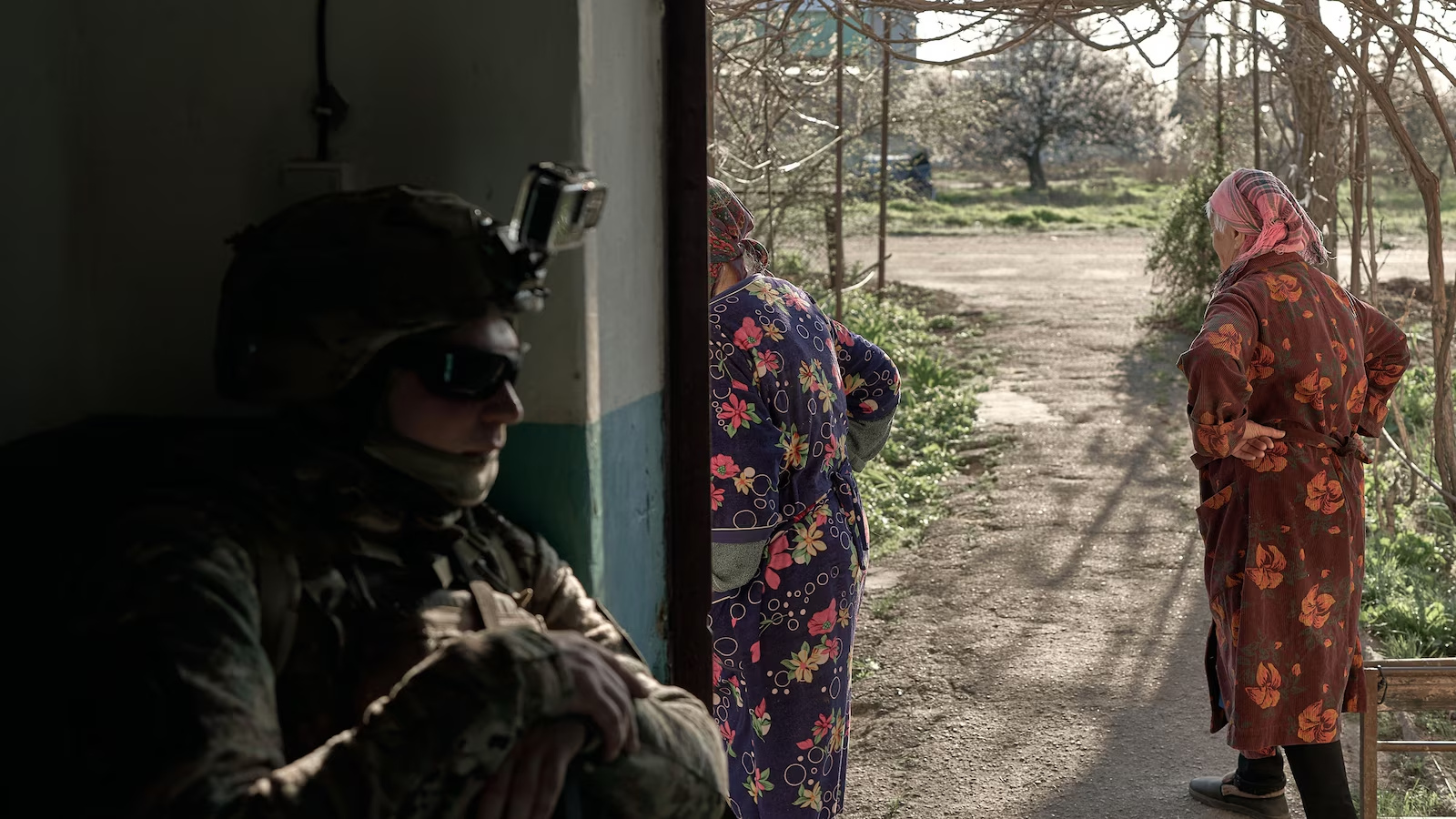
LONDON — In the frontline Ukrainian city of Kherson, Russian drones are never far away.
For Natalia Sergienko, a humanitarian worker and the director of the Kherson Power of the South public organization, the past month brought two close calls.
The first came when she was driving in the so-called “red zone” — an area which Russian military-linked Telegram channels have declared an open-fire area but that includes heavily populated parts of the city. “Thank god, it flew past my car, then it was shot down,” Sergienko told ABC News in an interview in early September.
Days later, Sergienko was taking a phone call close to her organization’s humanitarian headquarters. “A few seconds later I heard the sound of a drone behind me. It was not far,” she recalled. Sergienko said she ran, desperately seeking cover. “The basement saved me,” she said.
Such experiences are not uncommon in Kherson. The city sits along the banks of the Dnipro River, which since Kherson’s liberation by Ukraine in the fall of 2022 has formed the frontline between Ukrainian and Russian forces in the southern theater. Every day, the city is hit by Russian artillery, drones, missiles and air-dropped bombs launched from the opposite bank.

A drone view shows the Antonivskyi Bridge spanning the Dnipro River, with damaged buildings visible across the city of Kherson amid ongoing Russian attacks on the southern Ukrainian frontline city on April 7, 2026 in Kherson, Ukraine.
Libkos/Getty Images
Russian attacks on the city kill or injure around 20 people each day, local officials have said.
It was in Kherson that the phrase “human safari” was coined to describe Russian operators using FPV drones to hunt and kill civilians. Videos of the attacks are routinely shared on Russian military-aligned Telegram channels. The United Nations’ Independent International Commission of Inquiry on Ukraine said such attacks constitute crimes against humanity.
As the White House stokes new hopes — however distant — of a peace deal to end Russia’s full-scale invasion of Ukraine, now deep into its fifth year, frontline cities like Kherson, Kharkiv, Kramatorsk and many others face the possibility of an open-ended war regardless of any deals struck in far-off Moscow or Kyiv.
The Kherson region is one of four the Kremlin claimed to have annexed in September 2022 referenda that were widely dismissed as sham elections. Those four regions claimed by Moscow — Kherson, Zaporizhzhia, Donetsk and Luhansk — are on both the geographic and ideological frontlines of the Kremlin’s war of aggression.

A vehicle equipped with electronic warfare equipment drives under an anti-drone net on a road through an agricultural field on June 2, 2026 in Kherson, Ukraine.
Global Images Ukraine via Getty
‘Deliberate terror’
Almost 80% of Kherson’s pre-war population of around 283,000 people have already left the city, whether in the opening days of the invasion before Kherson was occupied by Russian forces, or in the period since its November 2022 liberation, Oleksandr Tolokonnikov — the deputy head of the Kherson Regional Military Administration — told ABC News.
Local government data shared with ABC News reports that at least 1,502 people — among them 40 children — have been killed by Russian fire in the Kherson region since the start of the full-scale invasion in February 2022. Another 9,625 people have been injured. At least 46,900 civilian infrastructure facilities have been damaged or destroyed, including more than 44,500 homes and apartment buildings, the data shows.
FPV drones pose a ubiquitous threat, Tolokonnikov said. Residents get no warning of the small craft crossing the river to attack, and those guided by fiber optic wires — which are increasingly common — are difficult to jam. “Russian occupiers use them as a tool of deliberate terror against civilians — drone operators don’t care who they target,” he explained. Civilians on foot — including children — taxis, buses and even ambulances are routinely attacked, Tolokonnikov said.

Residents of Kherson walk past a mobile concrete shelter in the city’s “red zone,” considered the most dangerous area due to frequent military operations, in Kherson, Ukraine, on June 3, 2026.
Nurphoto/NurPhoto via Getty Images
The drones are “a really huge problem,” Tolokonnikov continued. In August alone, authorities recorded 27,210 Russian drones launched across the river. FPV drones, he added, accounted for 80% of civilian casualties across the month, killing 30 people and wounding 393 others. The Russians are currently launching around 6,500 drones against Kherson each week.
The scale of Russian drone, artillery and air-dropped bomb attacks on Kherson are all increasing, he said. In the first half of 2026, for example, Russian jets dropped 117 aerial bombs on the Kherson region. Across the 31 days of August, the Russians dropped 100.
Alongside the nonstop attacks, the Ukrainian-held city is now also grappling with a severe energy crisis caused by Russian strikes. Earlier this month, Kherson Regional Military Administration head Oleksandr Prokudin urged residents to leave, warning that the electricity supply to the city is now equivalent to that received by a single Kyiv supermarket.
Ukrainian officials are expecting another winter of intense Russian strikes on energy infrastructure, a tactic Moscow has employed each winter of the full-scale invasion in a bid to freeze the country into submission.
Kherson will not be able to rely on its remaining heat and power plant this winter, Tolokonnikov said. Russian guided aerial bombs destroyed the facility in August. Authorities expect that 10% to 15% of remaining residents might leave for the winter months, Tolokonnikov added, perhaps more if the situation deteriorates further.

A Russian drone carrying a munition lies on anti-drone netting on June 3, 2026 in Kherson, Ukraine.
Global Images Ukraine via Getty
‘The shield of southern Ukraine’
Last weekend’s shuttling of President Donald Trump’s special envoy Steve Witkoff and son-in-law Jared Kushner between Moscow and Kyiv did not appear to jumpstart significant progress on the road to peace.
Witkoff, Kushner and officials in both Moscow and Kyiv suggested that the visits were productive, with Witkoff describing the diplomatic tour as “very meaningful.” But their remains no indication that Russian President Vladimir Putin is ready to abandon his maximalist war goals and no sign that Ukrainian President Volodymyr Zelenskyy is willing to surrender swaths of territory in the east of the country or accept Kremlin-imposed limits on Kyiv’s sovereignty.
When discussing U.S.-Russian diplomatic talks in February 2025, Kremlin spokesperson Dmitry Peskov said that Russian control over Kherson, Zaporizhzhia, Donetsk and Luhansk is “undeniable and non-negotiable.”
The recent visits by Witkoff and Kushner, Peskov said last week, represented “one small step toward peace.”
During the initial phase of Russia’s invasion of Ukraine — from 2014 to the launching of the full-scale invasion in 2022 — the Minsk I and Minsk II agreements sought to end the fighting and chart a route toward peace. The accords failed to stop the war, creating a frozen conflict with an ever-rising human toll that ultimately gave way to a full-scale invasion.
Many in Ukraine fear that those living along the current 754-mile front line may face a similar reality, even if the American negotiating team can force a deal to pause or nominally end Moscow’s full-scale invasion.
Any respite from the daily attacks would be welcome in Kherson, Tolokonnikov said. But the danger posed from the eastern side of the river “won’t disappear on its own.” In building a more secure city and region after the war’s eventual end, he added, “we will not start from scratch, we will continue to use our experience of these years.”

A screen displays an intercepted live feed from a Russian FPV drone as it flies on a course toward the city on April 7, 2026 in Kherson, Ukraine.
Libkos/Getty Images
Sergienko, the humanitarian worker, told ABC News she was concerned about a frozen war. “A ceasefire is not peace,” she said. “Even if a ceasefire is reached, it will likely be temporary. Russia has repeatedly broken agreements and failed to honor its promises, making it an aggressor that cannot be trusted. Accepting a pause without real security guarantees would be a huge risk for Ukraine.”
Four and a half years into the war, Sergienko said, visits by peace delegations should be delivering results. “How many people have already died, how many cities and villages will be destroyed? Unfortunately, the end of the war is not in sight. The next visit should end this damn war.”
Ukrainian forces liberated Kherson from eight months of Russian occupation — during which locals and officials Kyiv said the city saw widespread Russian war crimes — in November 2022, the victory crowning a 10-week Ukrainian counteroffensive on the southern front. Soldiers and civilians celebrated together in the streets, sharing fresh watermelons — a traditional symbol of Kherson.
The years since have seen that joy give way to exhaustion, Sergienko said. “Kherson is more than a frontline city — it is the shield of southern Ukraine, holding back the enemy, protecting the road to Mykolaiv and Odesa. The suffering our people endure each day is the price of preventing this war from spreading farther across the south.”

A man walks past the destroyed building of the Kherson Regional Military Administration in Kherson, Ukraine, on June 3, 2026.
Nurphoto/NurPhoto via Getty Images
Meanwhile, on the Russian-held side of the river — which accounts for around 75% of the territory of the Kherson region — Tolokonnikov said Ukrainians are still living under severe duress.
Food, medicine, water, gas and electricity are all in short supply, he said, while Russian troops are prioritized for treatment at scant medical facilities. Human rights abuses, forced mobilization of men for the Russian armed forces and pro-Moscow indoctrination of children in schools are all rampant, Tolokonnikov said.
In the event of a ceasefire that leaves Kherson split, “We will not be able to simply move on,” Tolokonnikov said. “This issue must be resolved and our people on the east bank must be liberated.”
“The liberation of our territories is possible,” Tolokonnikov added, noting that many people were skeptical that Ukrainian forces could free the territory ultimately liberated during the 2022 southern counteroffensive. Still, he acknowledged Kherson’s full liberation may prove a long-term aspiration. “It’s important to remain realistic and not create false expectations for people,” he said.
The sounds of eventual victory, Tolokonnikov said, might be heard in the echoes of an earlier chapter of Ukrainian history. The Soviet Union, he said, “was even more powerful than Russia is today. Eventually, countries still broke free from its control.”

Two women hide from an FPV drone circling overhead, listening to the sky and trying to locate it, as police officers inspect residential neighborhoods in Kherson’s red zone, on April 5, 2026 in Kherson, Ukraine.
Libkos/Getty Images