There are moments in pop culture when an artist stops performing for the crowd and starts performing for themselves. This was one of those moments. What unfolded in the California desert on April 11 did not look like a headline set built for spectacle. It looked more like a man sitting alone with his past, projected onto the largest stage in modern music culture.
Let’s be clear. This was not a technical failure or a last-minute improvisation. Justin Bieber showed up at Coachella 2026 with a concept in mind. A laptop. A desk. A catalog of his own internet history. And a willingness to let tens of thousands of people watch him scroll through it.
For a festival that reportedly spends around 10 million dollars on a headliner slot, the reaction was inevitable. Some saw laziness. Others saw something far more complicated.
A Headliner Set That Refused to Perform
Here’s what actually happened. Bieber’s set leaned heavily into minimalism. Instead of the expected choreography and tightly scripted spectacle, he positioned himself behind a MacBook, facing a camera that projected his silhouette onto massive screens. The crowd watched as he played clips from YouTube, including his own childhood uploads and viral internet moments.
He revisited early milestones, sang along to throwbacks like Baby and Never Say Never, and even pulled up viral clips like the Deez Nutz video. At one point, he reenacted his now widely circulated paparazzi line about “standing on business,” a moment that has taken on a life of its own online.
The set opened with All I Can Take and stretched to about 18 songs, blending nostalgia with newer material from his 2025 album Swag. There were also bloopers from past performances, including onstage falls, which gave the whole experience an almost home video quality.
What makes this interesting is not just the format. It is the refusal to meet expectations. Coachella is built on scale. Bieber brought intimacy instead.
Why This Feels So Unusual
Festival headliners are not just performers. They are spectacles. We’re talking about massive visuals, surprise choreography, and tightly controlled narratives. Even artists known for vulnerability tend to package it within high production value.
Bieber did the opposite. There was little crowd interaction. No extended monologues. No attempt to guide the audience through what they were seeing. The silence itself became part of the performance.
Meanwhile, fellow headliner Karol G took a more traditional route, leaning into crowd energy and anticipation with a straightforward message to fans. The contrast was hard to ignore.
So the question becomes obvious. Why take the biggest stage in American festival culture and strip it down to something that feels almost private? Because maybe that is the point.
The Psychology of Letting Go in Public
Here’s the thing. Bieber’s career has always been tied to the internet. He was discovered on YouTube. His rise was built on visibility, access, and constant consumption.
Now, years later, he returns to that same platform not as a launchpad, but as a mirror.
There is something psychologically revealing about choosing to revisit your own digital footprint in front of a live audience. It suggests reflection. Maybe even confrontation. Not with critics, but with self.
After years of intense public scrutiny, health challenges, and a very public pause following his Ramsay Hunt Syndrome diagnosis, this performance felt less like a comeback and more like a recalibration.
He is not trying to be the version of himself that filled arenas in 2015. He is trying to exist alongside that version without being consumed by it. But is that satisfying for fans who paid for a spectacle? That depends on what they came to see.
The Shadow of the Industry and the Cost of a Childhood
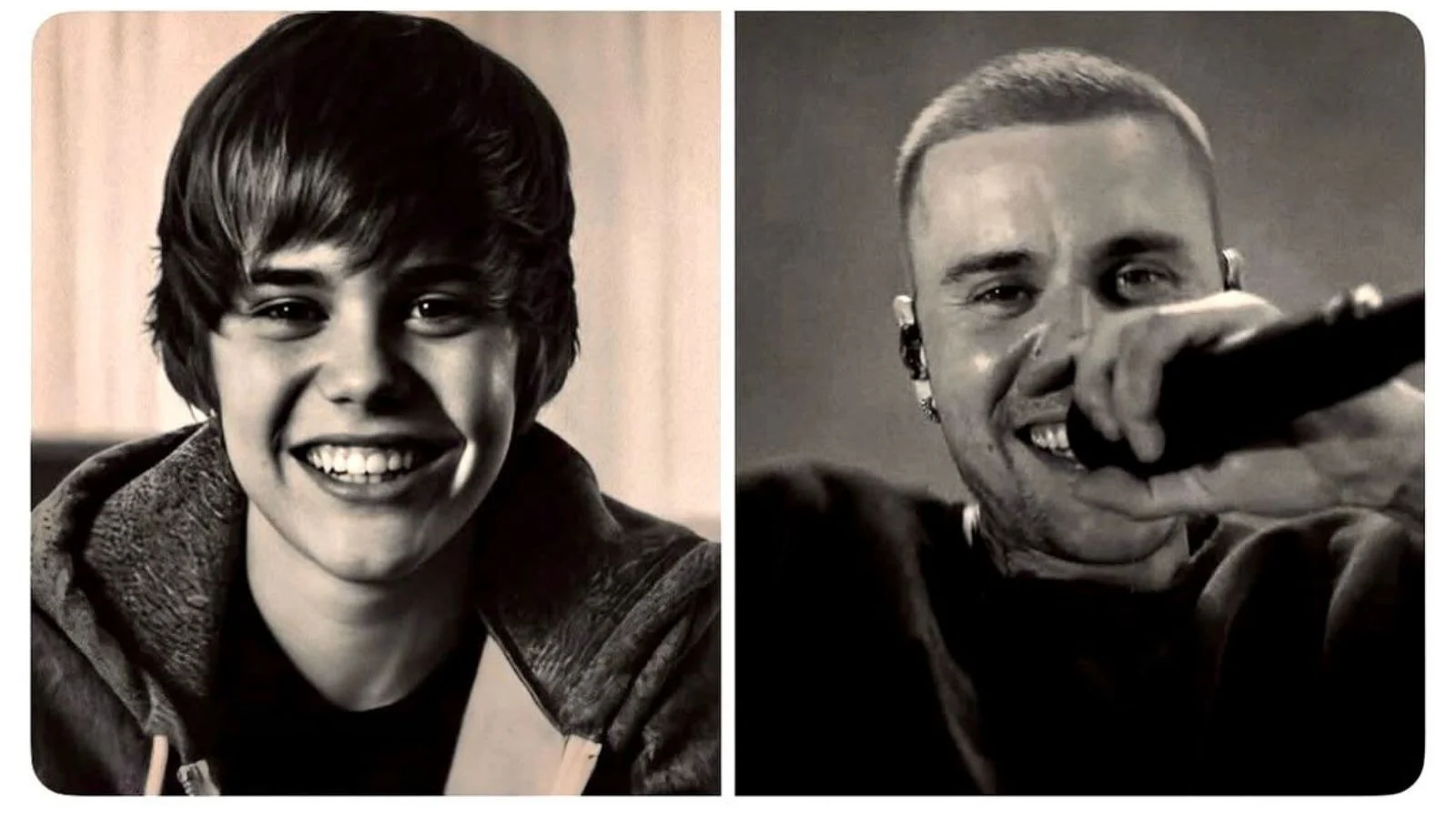
Justin Bieber at Coachella performing onstage with younger self pre fame.
It’s hard to believe so many people still seem so oblivious about what we’re really watching here. pic.twitter.com/ltKaefJpSz
— Natism (@his4Everz) April 12, 2026
Justin Bieber has spent most of his life inside an industry that discovered him as a child and scaled him into a global product at record speed. When he pulled up those early 2007 YouTube covers, he was not just revisiting old clips; he was reintroducing the version of himself that existed before management structures, contracts, and global expectations reshaped his identity.
What makes this fascinating is how it aligns with a broader cultural conversation. There has been increasing scrutiny around how young artists are developed, marketed, and, in many cases, consumed by the system that builds them. The language around it has shifted. People are more willing to question the long-term psychological cost of early fame.
Bieber did not say any of that out loud on stage. He did not need to. Instead, he let the imagery carry the weight.
He has hinted at personal struggles before, sometimes directly, sometimes in fragments. We’ve seen emotional posts. Moments of visible exhaustion. A sense that the machine kept moving even when he needed it to stop. In that context, the stripped-down Coachella setup starts to look less like a lack of effort and more like a boundary.
The MacBook becomes more than a prop. It becomes distant. A layer between him and a stage that traditionally demands everything at once. Energy, perfection, access…
And here is the contradiction. He is still showing up. Still performing. Still engaging. But on terms that feel deliberately controlled.
The Long Road to This Stage
To understand this moment, you have to look at the timeline.
After stepping back from touring in 2023, Bieber largely disappeared from the traditional pop cycle. Then in July 2025, he returned with Swag, a surprise album announced just hours before release. It debuted at No. 2 on the Billboard 200, moving 163,000 units in its first week and earning him another top-10 entry on the chart.
The reception was mixed. The sound connected, but the emotional tone left some listeners unsure of where he stood. That same tension followed him into Coachella.
There were also business realities in the background. Reports confirmed that he settled a $26 million debt with former manager Scooter Braun not long before the performance. Add that to years of public pressure, and the context becomes harder to ignore.
The Internet Reacts in Real Time
The difference in performance quality is actually insane. You’re telling me Justin Bieber is the highest-paid artist at Coachella, and this is what he delivers? Male artists really do get away with anything when it comes to performances — and more. I’ve seen people dragging… pic.twitter.com/LnoqxkOwc4
— jameshaschanged. (@_badreputatio_n) April 12, 2026
If the performance felt like a conversation with the past, the reaction was firmly rooted in the present.
Online, the divide was immediate. Some viewers saw a headline slot that did not deliver the expected spectacle. Others saw an artist choosing honesty over performance.
At the same time, clips from the night tell a slightly different story. The crowd stayed. The engagement did not collapse. And moments of vocal performance, especially on the softer R&B cuts from Swag, reminded people that the core talent is still intact.
Guest appearances from Tems, Wizkid, The Kid LAROI, Dijon, and Mk.gee added energy and balance, pulling the set back into a shared experience.
So even within the criticism, there was attention. People watched. People argued. People stayed. That alone says something.
The Bigger Cultural Shift
What makes this moment stick is the contradiction at its core. We have a global superstar. A 10-million-dollar stage. And a performance that feels deliberately small.
It reflects a broader shift happening across entertainment. The idea that authenticity, or at least the appearance of it, is starting to carry more weight than polish. Audiences are just as interested in the person as they are in the performance.
But there is tension there, too. Fans still expect value. Energy. Effort. And when those expectations are challenged, the backlash is immediate.
Bieber’s set sits right in the middle of that tension. It is not entirely satisfying. It is not entirely disappointing. It is something harder to categorize.
And maybe that is why people cannot stop talking about it. Because in a culture obsessed with bigger, louder, and more, he chose to go smaller. And in doing so, he forced everyone watching to decide what they actually came for.