With the war in Iran now past the 12-week mark, President Donald Trump has threatened for weeks to restart attacks if the country doesn’t reach a deal with the U.S., but has yet to commit.
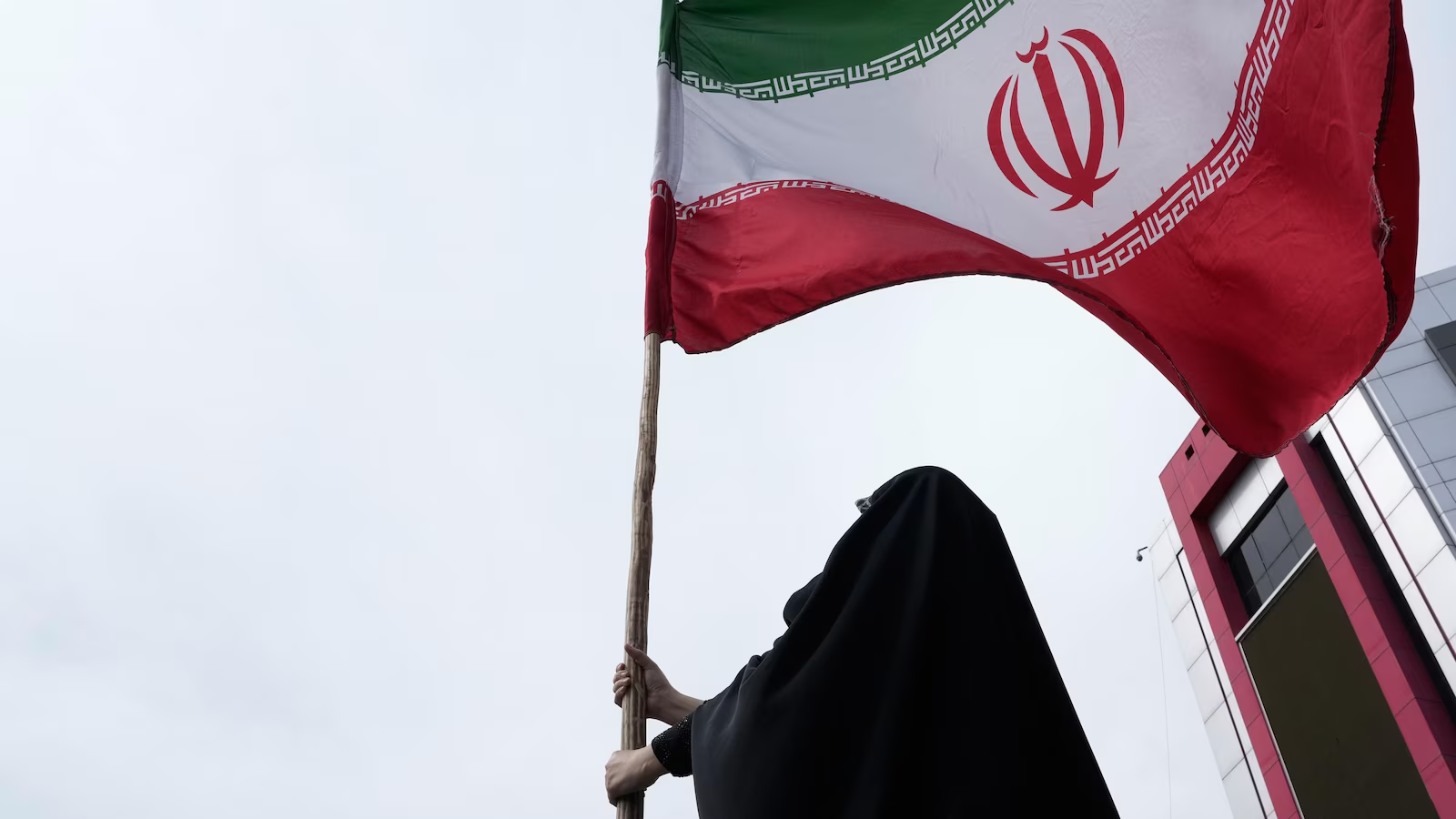
Trump has demanded that Iran open the Strait of Hormuz and turn over enriched uranium to prevent it from developing nuclear weapons.
Meanwhile, the impact of the war at home is severe.

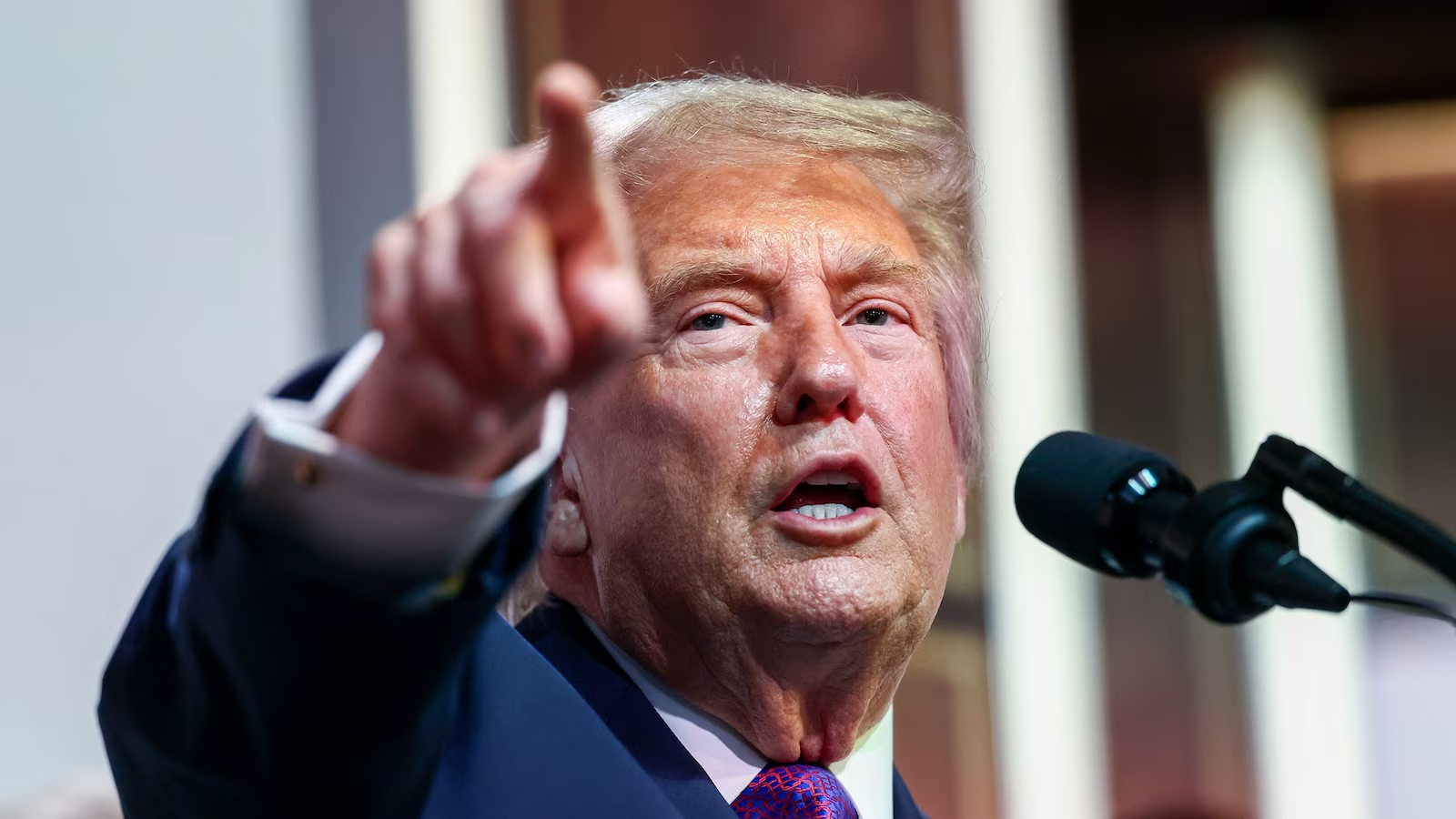
President Donald Trump speaks about prescription drug prices in the South Court Auditorium in the Eisenhower Executive Office Building on the White House campus, May 18, 2026, in Washington.
Jim Lo Scalzo/pEPA/Shutterstock
The latest inflation report shows prices are at their highest in three years, driven by the spike in fuel costs caused by the closure of the Strait of Hormuz, through which about 20% of the world’s oil passes through.
On Monday, a day after threatening to resume bombing Iranian targets, Trump again hit pause, saying that several Middle Eastern allies believe the U.S. is “getting very close to make a deal” with Iran.
“I’ve put it off for a little while, hopefully, maybe forever, but possibly for a little while, because we’ve had very big discussions with Iran and we’ll see what they amount to,” Trump told reporters at an event at the White House. “I was asked by Saudi Arabia, Qatar, UAE and some others if we could put it off for 2 or 3 days, a short period of time, because they think that they are getting very close to making a deal.”
Here is a look at the deadlines Trump has set for the Iranians:
March 21
Less than a month into the war, Trump threatened large-scale attacks on Iran’s power plants if it did not fully open the Strait of Hormuz to shipping.
“If Iran doesn’t FULLY OPEN, WITHOUT THREAT, the Strait of Hormuz, within 48 HOURS from this exact point in time, the United States of America will hit and obliterate their various POWER PLANTS, STARTING WITH THE BIGGEST ONE FIRST!” Trump posted on his social media platform.

A U.S. Air Force F-35 Lightning II receives fuel from a KC-135 Stratotanker in the U.S. Central Command area of responsibility, May 11, 2026.
Senior Airman Adriana Jordan-Alcaniz/USAF
March 23
Two days later, Trump announced progress was being made and that the strikes were postponed for five days.
“BASED ON THE TENOR AND TONE OF THESE IN DEPTH, DETAILED, AND CONSTRUCTIVE CONVERSATIONS, WHICH WILL CONTINUE THROUGHOUT THE WEEK, I HAVE INSTRUCTED THE DEPARTMENT OF WAR TO POSTPONE ANY AND ALL MILITARY STRIKES AGAINST IRANIAN POWER PLANTS AND ENERGY INFRASTRUCTURE FOR A FIVE DAY PERIOD, SUBJECT TO THE SUCCESS OF THE ONGOING MEETINGS AND DISCUSSIONS,” the president wrote.
March 26
Three days later, Trump extended holding off on attacks for 10 more days, saying talks with the Iranians were going “very well.”
“As per Iranian Government request, please let this statement serve to represent that I am pausing the period of Energy Plant destruction by 10 Days to Monday, April 6, 2026, at 8 P.M., Eastern Time,” Trump said then.
April 5
Two days before the end of the 10-day deadline, Trump extended the deadline by a day.
“Tuesday, 8:00 P.M. Eastern Time!” Trump posted.

An Iranian man walks next to a mural on a street in Tehran, Iran, on May 11, 2026.
Majid-asgaripour/via Reuters
April 7
Two days later, Trump announced, after consulting with Pakistani mediators, a two-week ceasefire, contingent on Iran opening up the Strait of Hormuz, and declared the “Longterm problem” was “close to resolution.”
“This will be a double sided CEASEFIRE! The reason for doing so is that we have already met and exceeded all Military objectives, and are very far along with a definitive Agreement concerning Longterm PEACE with Iran, and PEACE in the Middle East. We received a 10 point proposal from Iran, and believe it is a workable basis on which to negotiate. Almost all of the various points of past contention have been agreed to between the United States and Iran, but a two week period will allow the Agreement to be finalized and consummated,” Trump posted.
April 21
When the two weeks were up, bombing did not resume and instead Trump announced an indefinite ceasefire, saying it was at the request of the Pakistanis.
“Based on the fact that the Government of Iran is seriously fractured, not unexpectedly so and, upon the request of Field Marshal Asim Munir, and Prime Minister Shehbaz Sharif, of Pakistan, we have been asked to hold our Attack on the Country of Iran until such time as their leaders and representatives can come up with a unified proposal,” Trump wrote.

This screen grab made on May 10, 2026, from a video released by the U.S. Central Command on its X account on May 8, 2026, appears to show a strike on the Iranian-flagged tanker M/T Sevda. U.S. forces fired on and disabled two Iranian-flagged tankers that attempted to violate the American blockade of Iran’s ports on May 8, 2026, the U.S. military said.
U.S. Central Command Public Affairs/AFP via Getty Images
May 18
A day after Trump said Iran “better get moving, FAST,” and warned that “there won’t be anything left of them” if it didn’t make a deal, Trump posted that he had agreed to hold off on a planned attack that was to take place the next day, this time at the request of allies in Qatar, Saudi Arabia and the United Arab Emirates, because “serious negotiations are now taking place.”
“I have instructed Secretary of War, Pete Hegseth, The Chairman of The Joint Chiefs of Staff, General Daniel Caine, and The United States Military, that we will NOT be doing the scheduled attack of Iran tomorrow, but have further instructed them to be prepared to go forward with a full, large scale assault of Iran, on a moment’s notice, in the event that an acceptable Deal is not reached,” Trump posted.