ATLANTA — Georgia Republicans will keep duking it out among themselves as they head toward a runoff to pick their candidates for governor and U.S. Senate in the battleground state after Tuesday’s primary failed to produce outright victors.
The Senate runoff will feature former college football coach Derek Dooley and Rep. Mike Collins, while Rep. Buddy Carter was knocked out of the race. The winner will go up against Democratic Sen. Jon Ossoff in one of the most closely watched campaigns in the November midterm elections.
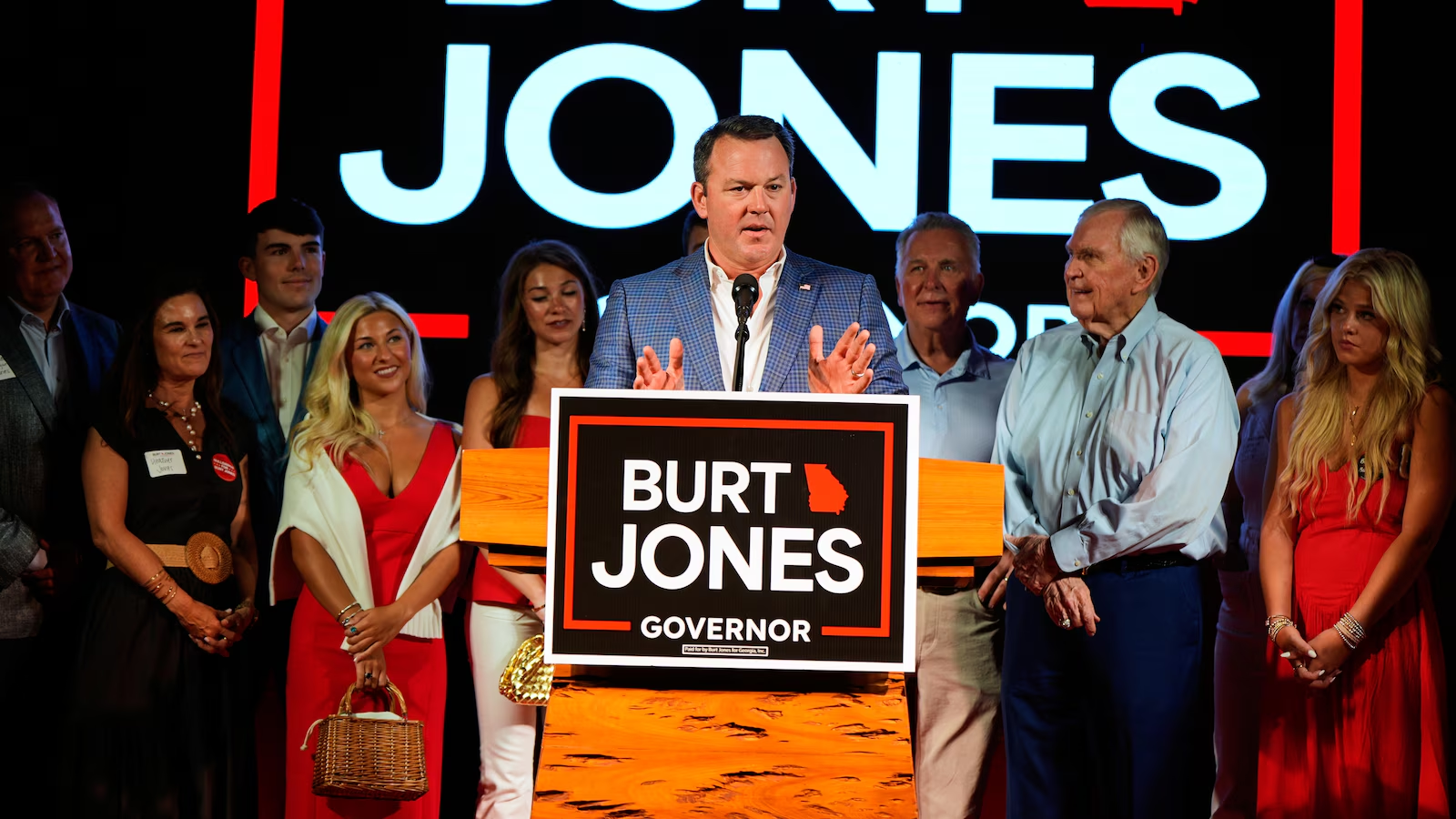
Lt. Gov. Burt Jones and healthcare billionaire Rick Jackson advanced to the runoff in the Republican primary for governor, extending their bruising and expensive campaign battle. Former Atlanta Mayor Keisha Lance Bottoms clinched the Democratic nomination on Tuesday.
With about a month to go until the June 16 runoff, Republicans will spend more time and money competing among themselves before they turn their attention to their Democratic opponents in key races.
Ossoff is the only Democratic senator in the country seeking reelection this year in a state that President Donald Trump won two years ago, making him a tempting target for Republicans as they defend their Senate majority.
Bottoms hopes to become the first Democrat to win a Georgia governor’s race since 1998. She received a rare endorsement from former President Joe Biden after serving in his administration, and she said Tuesday night that she wanted to make sure “every Georgian has an opportunity to succeed.”
“It means stopping Donald Trump every time his policies hurt Georgia, and also taking action here to make life better for people across the state,” she said.
Ossoff, 39, had no opposition in Tuesday’s primary. This is his first reelection campaign. He has positioned himself as a critic of political corruption, targeting Trump and his sons for business dealings that have enriched the first family.
Meanwhile, the Republican primary has been a test of fealty to the president, who did not endorse a candidate. Collins, Dooley and Carter each said they would be the best person to advance Trump’s agenda in Washington.
In addition, Collins faced attacks over a House ethics complaint accusing him of abusing taxpayer funds by paying the girlfriend of a top aide for work she allegedly didn’t perform. The Office of Congressional Conduct, after an initial inquiry, has referred the matter to the House Ethics Committee.
“If taxpayers can’t trust you to properly steward their money, how can they trust you to be a U.S. senator?” Carter asked Collins in a primary debate.
“Buddy,” Collins shot back, “I can tell through your voice that you know how the polling is going out there.”
Collins sponsored the Laken Riley Act, a 2025 law that requires immigrants be detained when charged with certain crimes. Republicans believe the issue damages Ossoff because he initially voted against the measure before supporting it after Trump returned to the White House.
“You can replace a Democrat with an actual conservative,” Collins said Tuesday night.
More than $125 million has been spent on advertising in the Republican primary for governor, with more than $66 million of that spent by Jackson’s campaign, according to the latest figures from ad-tracking firm AdImpact. By contrast, Democrats running for governor have only spent about $4 million.
Jones argues that his conservative record as a state senator and lieutenant governor, combined with Trump’s endorsement, should make him the clear choice for Republican voters.
“I think Georgia just spoke, y’all,” Jones said at his election night party. He added, “I could not leave this stage without thanking President Donald J. Trump.”
A win from Jones would boost the president’s influence in Georgia after a string of setbacks. Trump failed to dislodge Gov. Brian Kemp and others in 2022, and he backed Herschel Walker’s losing campaign against Democratic Sen. Raphael Warnock that year.
However, Jackson is betting that his outsider pitch will win over antiestablishment conservatives. On Tuesday night, he called Jones a political insider who is “working inside the system for his own benefit.”
“I cannot be bought, and I will not back down,” Jackson said.
Democrat Jasmine Clark won her party’s nomination on Tuesday to succeed Rep. David Scott for a two-year term representing Georgia’s 13th Congressional District after Scott died in April while seeking another term.
Clark is a state representative, microbiologist and a lecturer at Emory University who has promised to prioritize science in Congress. Her candidacy was boosted by more than $2 million in outside spending by cryptocurrency interests, but Clark said she did not court the support.
Clark will be the odds-on favorite to succeed Scott for a full term starting next January, with Jonathan Chavez unopposed to become the Republican nominee.
In the 11th District northwest of Atlanta, Loudermilk announced his retirement and endorsed staffer Rob Adkerson, who advanced to a runoff against neurologist John Cowan.
In the 10th District east of Atlanta, state Rep. Houston Gaines is the top Republican seeking to take the departing Collins’ seat. Jim Kingston, the son of longtime U.S. Rep. Jack Kingston, is the top Republican to take Carter’s seat in coastal Georgia’s 1st District.
In northeast Georgia’s 9th District, three-term Republican incumbent Andrew Clyde fended off primary challenges from former Gainesville Mayor Sam Couvillon and Hall County Commissioner Gregg Poole.
Tuesday was the general election for Georgia’s judgeships. The posts are technically nonpartisan, but eight of the nine justices on the state Supreme Court were appointed by Republicans governors.
Democrats hoped strong turnout could produce the first defeat of an incumbent justice since 1922. However, Justice Sarah Hawkins Warren won over Democrat-supported former state Sen. Jen Jordan, and Justice Charlie Bethel defeated Democrat-support Miracle Rankin. A third justice, Ben Land, is unopposed for a six-year term.
The state Judicial Qualifications Commission, which investigates allegations of wrongdoing by judges, said in statements dated Sunday that Jordan and Rankin violated rules of judicial conduct by publicly endorsing each other and making statements supporting the restoration of abortion rights.
The commission said it reached its conclusions, which are not a final determination, after receiving and reviewing a complaint about each candidate.
State Democratic Party Chair Charlie Bailey called the commission’s statements “a cynical attempt by a mere bureaucratic arm of the Georgia Republican establishment to hide the truth about this race from Georgia voters.”
___
Amy is a former Associated Press reporter. Associated Press reporter Mike Catalini in Morrisville, Pennsylvania, contributed.