It is rarely a quiet week in cable news, where the line between political commentary and ideological combat is often blurred. Yet, the recent collision between the Vatican and the primetime spotlight has sent a jolt through the digital sphere that feels particularly sharp, even by modern standards.
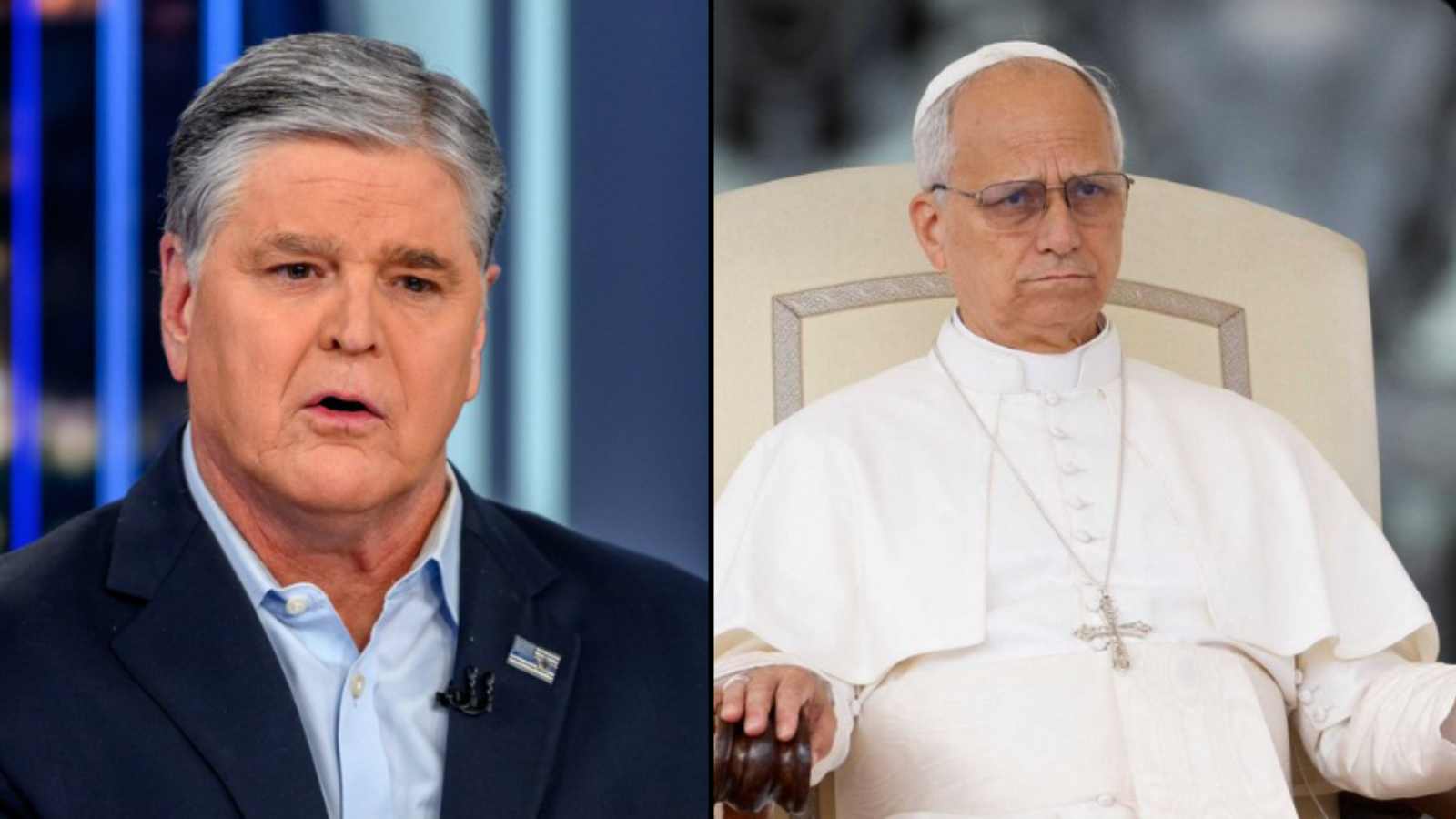
It started when the highest authority in the Catholic Church, Pope Leo XIV, the first American-born pontiff, found himself in the crosshairs of one of television’s most enduring conservative voices.
During a candid segment on his show this past week, Sean Hannity took a metaphorical magnifying glass to the Pope’s theological homework, posing a direct question that landed with the weight of a sledgehammer: “Have you even read the Bible?”
The tension emerged from a sharp disagreement over peace, specifically the Pope’s ongoing calls for an end to violence in various global conflicts. While the Vatican’s position is traditionally rooted in diplomacy, humanitarian aid, and a unified push for ceasefires, Hannity viewed these overtures through a different, more combative lens.
He expressed a deep frustration with what he perceived as a blanket refusal to acknowledge the necessity of conflict in certain contexts. To make his point, the host pointed directly toward the historical narratives of the Old Testament.
He referenced the battles of King Saul and the iconic imagery of David facing Goliath, using these stories not as allegorical teachings on faith, but as direct justifications for the use of military force to defeat enemies.
It was a moment that cut through the usual noise, pitting the modern-day pulpit against the studio desk in a raw display of ideological friction that has left audiences divided on exactly where the moral high ground truly lies in the face of ongoing global strife.
God does not bless any conflict. Anyone who is a disciple of Christ, the Prince of Peace, is never on the side of those who once wielded the sword and today drop bombs. Military action will not create space for freedom or times of #Peace, which comes only from the patient…
— Pope Leo XIV (@Pontifex) April 10, 2026
The Bible as a Tool or a Teacher?
The core of this disagreement lies in a fascinating, if rarely explored, tension: how different people interpret the same sacred texts to support vastly different political and moral worldviews. Hannity’s argument relies on a literalist interpretation where biblical battles serve as clear, active precedents for current geopolitical strategy.
By questioning if the Pope… a man who spent decades as a theologian, bishop, and leader of the Dicastery for Bishops before ascending to the papacy, has actually read the source material, the host was highlighting a fundamental divide in how the Bible is consumed in the public square.
On the one hand, there is the view that the Bible is a chronicle of conflict in which strength and divine favor are inextricably linked to victory over one’s enemies. On the other hand, the stance typically championed by the Vatican focuses on the latter: transformative calls for mercy, the sanctity of human life, and the pursuit of peace as the ultimate Christian vocation.
It is a classic, age-old struggle of “just war” theory versus absolute pacifism. What makes this particular incident so compelling is the public nature of the questioning. It forces the average viewer to decide: is the Bible a manual for maintaining national security through force, or is it a blueprint for radical, uncomfortable peace?
This isn’t just a political squabble; it is a fundamental question about how religious values are translated into the reality of the twenty-first century.
Is ‘Hate-Watching’ Hurting Our Discourse?
There is a deeper, perhaps more haunting reality hidden beneath this headline. During the segment, the exchange included an admission from one of Hannity’s producers, Lynda McLaughlin, that she “hate-watches” the Pope’s statements, a term that has become common parlance in our digital age.
This phenomenon of consuming media specifically to be angered by it is perhaps the most dangerous trend in our current media diet. When we approach world leaders or religious figures with the intention of being “ticked off,” the capacity for genuine listening evaporates, replaced by the impatient wait for a turn to speak.
The take here suggests that Hannity’s swipe at the Pope… while generating massive engagement, actually highlights a collective failure to engage with complexity.
By boiling down the multi-millennial tradition of Catholic social teaching into a binary question of “have you read the book?”, the ability to have a nuanced conversation about why the Pope calls for peace, even when it feels strategically disadvantageous, is lost.
Is it possible that the Pope’s calls for peace are meant to be an aspirational goal, a “guiding star” rather than a tactical military recommendation? When news is consumed solely to confirm one’s own biases or to fuel outrage against a perceived adversary, the ability to see the humanity in a differing opinion vanishes.
Perhaps the real question isn’t whether the Pope has read the Bible, but whether the audience is capable of reading a headline without rushing to condemn the person standing behind it.
The Weight of the Papal Name
It is impossible to ignore the context of Pope Leo XIV’s name choice. Born Robert Francis Prevost in Chicago, the Pope chose his regnal name in honor of Pope Leo XIII, who was renowned for developing modern Catholic social teaching during the Industrial Revolution.
This deliberate nod to history suggests that Leo XIV views his papacy as a continuation of a specific mission: bridging the gap between ancient faith and the complexities of modern technological and geopolitical challenges.
Hannity’s pointed interrogation seems to miss the irony that Leo XIV is operating from a platform of deep study, having earned a Doctor of Canon Law degree in Rome decades ago, making the suggestion that he hasn’t read the scriptures a particularly aggressive rhetorical device.
The political fallout from this, however, extends well beyond a single cable news segment. President Donald Trump has also weighed in via social media, expressing frustration with the Pope’s criticisms of foreign policy and the ongoing war in Iran.
Reporter: Why did you attack Pope Leo?
Trump: I don’t think he’s doing a very good job. He likes crime I guess. We don’t like a pope who says it’s ok to have a nuclear weapon. We don’t want a pope that says crime is ok. I am not a fan of Pope Leo. pic.twitter.com/cj3oh1jSIL
— Acyn (@Acyn) April 13, 2026
This creates a fascinating triangle of influence: a populist political leader, an influential conservative media personality, and a religious leader attempting to act as a global moral arbiter.
As these three figures maneuver for space in the public consciousness, the average observer is left to wonder: in an era of hyper-partisan media, can the Vatican maintain its role as a voice for peace, or is it destined to be treated as just another political combatant in the culture war?
Beyond the Soundbite
Ultimately, the friction between Hannity and the Vatican serves as a mirror for our own societal polarization. We are increasingly living in silos where the “correct” interpretation of history, religion, and policy is set by our chosen media personalities.
The controversy has sparked discussions on platforms ranging from Reddit to traditional talk radio, suggesting that people are hungry for a way to reconcile their faith with their political identity.
However, when engagement is driven by the desire to “hate-watch” or to score points in a political arena, the opportunity for actual understanding vanishes.
Moving forward, the challenge for the public will be to look past the dramatic headlines and the aggressive rhetoric. Whether one agrees with Pope Leo XIV’s pacifist appeals or finds them out of touch with geopolitical realities, it is worth asking if the conversation can ever rise above the level of a TV studio monologue.
Can we move from asking, “Have you read the Bible?” to asking, “How do we apply these teachings to a world that feels increasingly on the brink of chaos?”
The answer, as always, is likely more complex than a soundbite could ever capture, and that is precisely why the dialogue between the pulpit and the press remains so essential, even when it is messy and deeply uncomfortable.