It is a moment that feels almost like a fever dream… a digital artifact plucked from the peculiar intersection of consequential politics and the uncanny valley of artificial intelligence.
Late this past Sunday, as the President was returning from Florida to Washington, his Truth Social account became the stage for a bizarre, surrealist pivot.
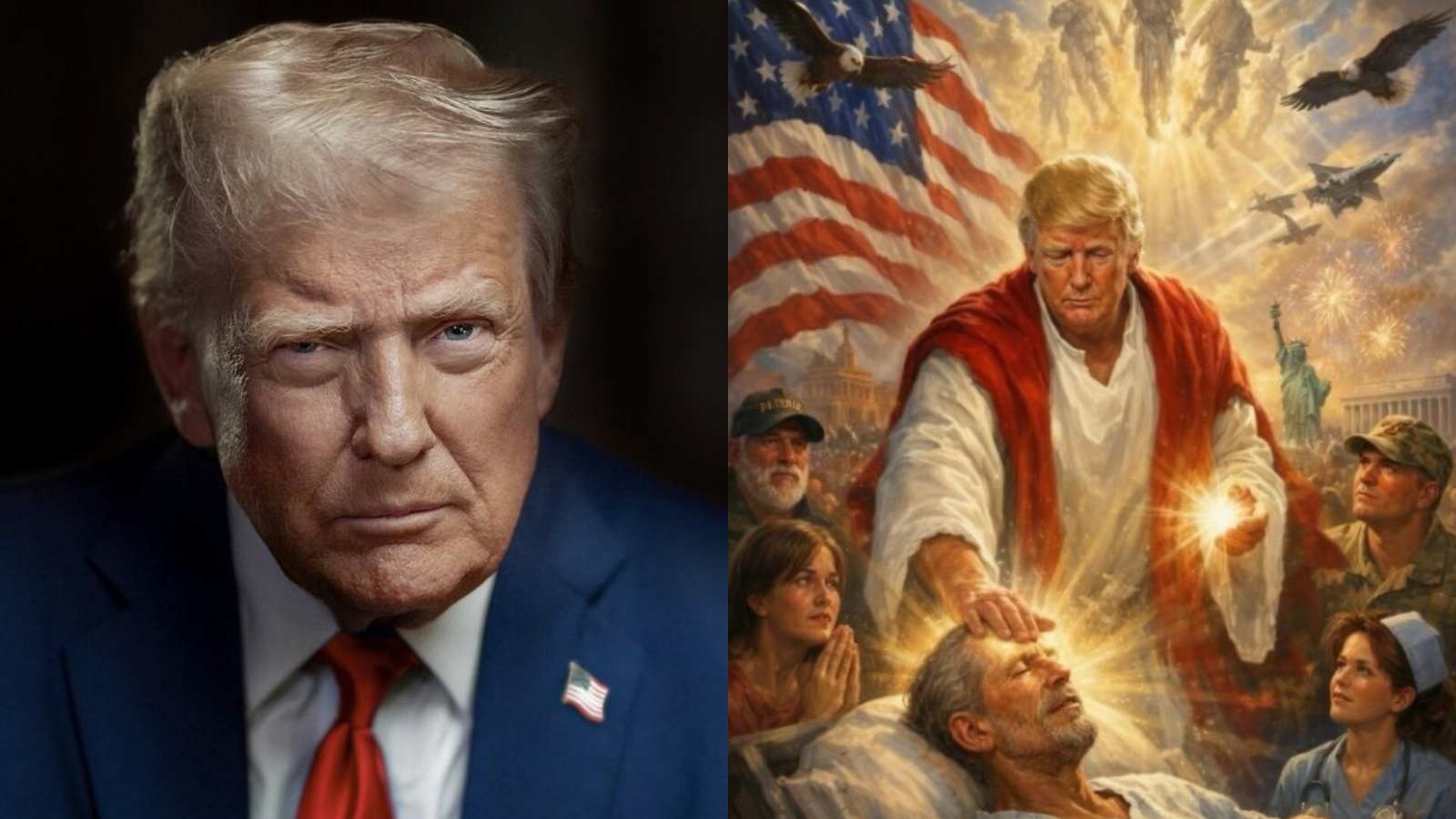
The feed, which had just finished hosting a scathing, fiery attack on Pope Leo XIV over the administration’s war in Iran, suddenly pivoted to a new, ethereal image. In this AI-generated rendering, President Donald Trump appears dressed in a long white robe and a red sash.
He is depicted holding a glowing orb in one hand, while his other hand rests upon the forehead of a man lying in a hospital bed, with light beaming from the man’s head as if in a miraculous healing gesture. The background is a dense, symbolic collage of the Statue of Liberty, fireworks, eagles, and fighter jets.
It sat on his platform for over twelve hours, a visual echo of the quasi-messianic imagery often pushed by his fringes, until it quietly vanished on Monday morning, leaving behind a wake of genuine, bewildered, and deeply indignant outrage from the very core of his religious base.
President Trump posts an AI-generated image depicting himself as Jesus on Truth Social pic.twitter.com/TBe9Hyl2UJ
— Faytuks Network (@FaytuksNetwork) April 13, 2026
When the Bedrock Cracks
The response to this specific post was not the standard partisan friction one expects in Washington; it was something far rarer and more personal. We are talking about the conservative evangelicals and Catholic influencers who have, for years, acted as the sturdiest, most unshakeable pillars of the Trump coalition.
They are the voices that have navigated every legal crisis and political tremor with their loyalty intact, yet this image served as a tripwire they could not overlook. The language used in the backlash was stark and immediate, marked by words like “blasphemy,” “disgusting,” and “outrageous.”
Megan Basham, a prominent conservative Protestant writer, publicly demanded that the President not only remove the image but offer an apology, not just to the public, but to God.
I assume someone has already told him, but it behooves the President both spiritually and politically to delete the picture, no matter the intent.
— Michael Knowles (@michaeljknowles) April 13, 2026
Michael Knowles, a conservative Catholic podcaster who has consistently aligned with the President’s agenda, argued that the post was a profound error, suggesting that, regardless of intent, it hurt the President both spiritually and politically.
Even Riley Gaines, a vocal ally who has frequently appeared at rallies and recently visited the White House, found herself unable to parse the motive, publicly questioning the humility behind such a depiction.
It was a visceral reminder that even in a movement defined by its loyalty to a singular figure, there are cultural and theological boundaries that, when crossed, trigger an instinctive recoil that transcends political strategy.
Why? Seriously, I cannot understand why he’d post this. Is he looking for a response? Does he actually think this?
Either way, two things are true.
1) a little humility would serve him well
2) God shall not be mocked https://t.co/GViHqWeDEr— Riley Gaines (@Riley_Gaines_) April 13, 2026
The Defiant Calculus of the Digital Stage
There is a unique, perhaps darker, angle to this entire ordeal that the standard political analysis often overlooks. While the public consensus focuses on the insult to religious sensibilities, we have to consider the possibility that this wasn’t merely an act of tone-deafness, but a calculated, albeit high-stakes, engagement test.
With the modern attention economy, where negative engagement is often just as valuable as positive, generating a controversy that forces your most loyal “gatekeepers” to openly criticize you is a fascinating, if dangerous, power play.
By forcing the podcasters, religious commentators, and influencers to publicly denounce him, the President effectively tested the limits of his own gravity within the party.
He’s attacking the Pope.
He. Is. Attacking. The. Pope. https://t.co/DbveAIyBhw— Jo (@JoJoFromJerz) April 13, 2026
He essentially asked: “Can I do this and still maintain your loyalty?” When they inevitably recoiled, he crafted a scenario in which he could be perceived as a martyr or misunderstood icon, further solidifying the “outsider” narrative that has sustained his influence for a decade.
Is it possible that this was a deliberate stress test to see who would fall in line and who would try to exert independence? By deleting the post, he avoided a long-term schism, but he proved that even a brief, surreal moment of digital sacrilege is enough to reset the entire conversation, forcing his strongest allies to reckon with their own influence, or lack thereof, in the face of his mercurial impulses.
Was this the ultimate troll or a simple lapse in judgment? Either way, it successfully moved the goalposts of what is considered “acceptable” discourse, ensuring that the entire nation spent its Monday morning talking about his image rather than his policy.