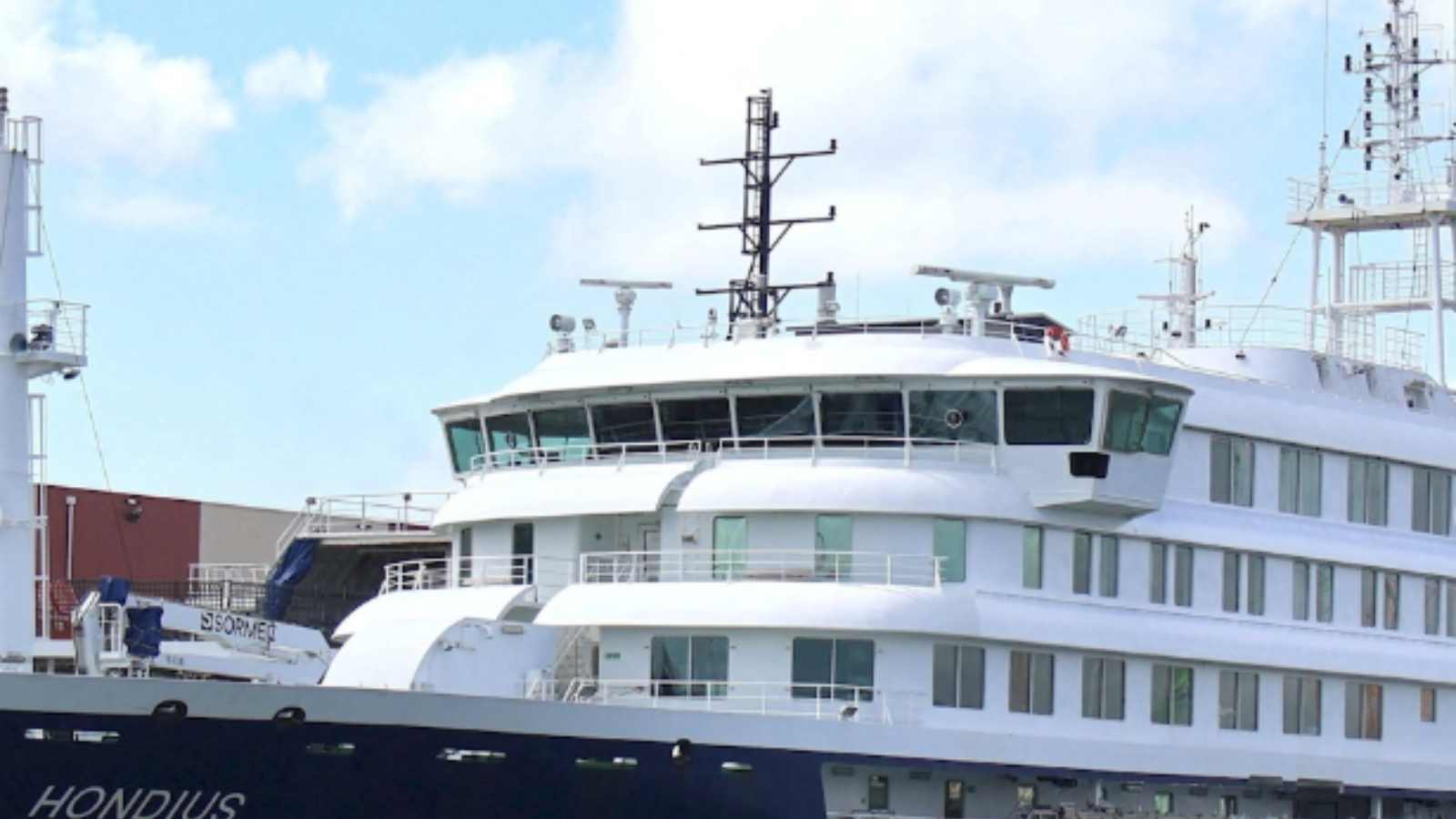
She paid somewhere between €14,000 and €22,000 (approximately $15,000 to $23,600) for the trip of a lifetime. An expedition to Antarctica, isolated South Atlantic islands, the kind of voyage that ends up in photo albums and dinner party conversations for years.
Instead, a French woman who boarded the Dutch cruise ship MV Hondius in Ushuaia, Argentina, on April 1 is now fighting for her life in a Paris hospital, after a disease that most people associate with rural rodents tore through one of the most expensive cruise ships in the Southern Hemisphere.
And here is the part that should make every single one of us pay attention: when she told doctors on board that she wasn’t feeling well, they didn’t suspect hantavirus. They didn’t suspect much of anything dangerous, actually.
According to Spanish Health Minister Javier Padilla Bernáldez, she had reported a coughing episode that had already passed by the time she was assessed.
The medical team from the European Centre for Disease Prevention and Control and the Spanish foreign health service evaluated her and concluded that what she was experiencing was, more or less, nerves. Stress. Anxiety.
They let her get on a plane to Paris. She tested positive for hantavirus shortly after landing. By the time this story reached global headlines on May 11, her condition was deteriorating rapidly.
That detail alone should stop you cold. A woman carrying a virus with a 38% fatality rate among severe respiratory cases was assessed, cleared, and sent home on a commercial evacuation flight, with four other passengers sitting in seats beside her.
All five of those co-travelers have since been placed in isolation protocols. It was not a failure of bad doctors or sloppy care. It was a failure that speaks to something far more sobering: hantavirus, particularly the Andes strain responsible for this outbreak, is extraordinarily good at masquerading as something else.
A Virus That Wears a Disguise
The Andes virus is the only known hantavirus strain that spreads from person to person. Every other variant of hantavirus requires direct contact with infected rodent urine, droppings, or saliva.
The Andes virus, found primarily in South America, has been documented to pass between humans through close, prolonged contact, including through shared respiratory secretions and, in some cases, possibly through the air itself.
The World Health Organization has confirmed it. The CDC has classified it as a Level 3 emergency response. And yet, because the disease is rare enough that most frontline clinicians outside of South America have never actually seen a case in person, it has an almost terrifying ability to masquerade as the flu, pneumonia, or, in this woman’s case, situational anxiety.
What makes the Andes virus genuinely frightening is not how quickly it spreads. It is how fast it moves once it gets going inside a patient. According to the CDC, symptoms of hantavirus pulmonary syndrome caused by the Andes virus typically appear between four and 42 days after exposure, starting with fever, muscle aches, and fatigue.
Those early signs are indistinguishable from dozens of other illnesses. Then, sometimes within hours, the lungs begin to fill with fluid. Patients can deteriorate so rapidly that delayed care is not just a setback. It cuts survival chances significantly.
The only treatment currently available is supportive care. There is no approved antiviral. However, the CDC notes that in severe cases, extracorporeal membrane oxygenation (ECMO) can raise survival rates to around 80% if deployed early enough. Time, in other words, is the entire ballgame.
Three Dead, a Ship That Wasn’t Wanted Anywhere
The MV Hondius left Ushuaia on April 1 with around 150 passengers and crew representing 23 nationalities. It was scheduled for Antarctica and several isolated South Atlantic islands.
What nobody knew was that the Dutch passenger who would become the outbreak’s index case had spent the four months prior on a road trip across Chile, Uruguay, and Argentina.
He boarded the ship four days after returning from Uruguay. He became symptomatic, died on April 11, and his body was removed from the vessel at Saint Helena on April 24, the same day his wife disembarked. She deteriorated mid-flight to Johannesburg and died on April 26 in the emergency department there. A third passenger also died on board.
By the time the WHO was formally notified on May 2, there were already two confirmed deaths and a critically ill patient being treated in South Africa.
What followed was a logistical and political drama that played out across multiple countries simultaneously. The ship docked in Praia, Cape Verde, for three days, but local facilities were deemed insufficient for the scale of the evacuation required.
The vessel then attempted to dock in the Canary Islands, where the regional government’s president, Fernando Clavijo, flatly refused it. He said he could not allow the ship to enter the Canaries, citing the safety of local residents and, explicitly, the memory of COVID-19.
The cruise company pushed back, arguing that Spain had a moral and legal obligation to take in its own citizens. Spain’s national health authority eventually overruled Clavijo, invoking international humanitarian law.
The ship arrived at the Port of Granadilla in Tenerife around 5:30 a.m. on May 10, and evacuation operations began immediately under what Spanish Health Minister Mónica García described as an “unprecedented” level of planning. Ninety-four people of 19 nationalities disembarked on day one.
American passengers were flown on a government medical repatriation flight to Offutt Air Force Base in Omaha, Nebraska, before being transported to the National Quarantine Center at the University of Nebraska Medical Center.
The Part That Doesn’t Add Up
Now here is where the story gets complicated in a way most outlets have glossed over. President Trump, addressing concerns about hantavirus in the United States, emphasized that the disease is “much harder to catch” and that it “seems like it is not easy to spread, and it is very much, we hope, under control.”
He expressed confidence that the country is “in very good shape.” And in the narrow, literal sense, he is not wrong. The CDC and WHO have both consistently stated that the risk to the general public remains extremely low.
The Andes virus requires close, sustained contact to pass from person to person. It is not Covid-19, a point that WHO Director-General Dr. Tedros Adhanom Ghebreyesus has repeated emphatically and publicly.
“This is not another COVID,” Dr. Tedros said during media appearances in Tenerife. He also noted, however, that the Andes virus has an incubation period of 6 to 8 weeks and that he expected additional cases to emerge among passengers who have already gone home.
That second part deserves a longer pause. As of May 11, nine total cases have been reported, with seven confirmed by laboratory testing. Three people are dead. One American passenger who returned to the United States has already tested positive.
The 42-day monitoring window for returning passengers means that the full picture of this outbreak will not be visible for at least another month, possibly longer.
The French woman’s situation, according to Dr. Tedros, was actually deteriorating even as he spoke to reporters. He added pointedly that if she had still been on the ship when her condition worsened, the outcome could have been far more dangerous.
The Question Nobody Wants To Ask
Here is the uncomfortable thought this story quietly raises: Is the global health community’s reassurance that this is “not another COVID” actually a useful message, or is it subtly undermining urgency?
Every time an official steps in front of a microphone to say the risk is low, the embedded message to the average person is: you do not need to worry about this.
And for the vast majority of people, that is genuinely true. But for the people who traveled on that ship, the people who sat near someone who coughed, the people who shared a dining room or a Zodiac boat with the index case over six weeks at sea, “low risk” is a statistical average that does not describe their actual situation.
The French woman’s story is a case study in exactly that gap. She was assessed. She was cleared. The symptoms she reported were not deemed “compatible with hantavirus” by the clinicians who examined her. She was low risk right up until she wasn’t.
The incubation window for the Andes virus is long enough that dozens of passengers who feel perfectly fine today may not yet know what is coming. Reassurance is not the same as safety.
What the MV Hondius outbreak has exposed, quietly but clearly, is that the global early-warning system for rare and exotic pathogens works better in press releases than it does in the exam room of a ship bobbing in the South Atlantic.
The doctors who assessed the French woman were not incompetent. They were working with the information in front of them, in a context where hantavirus was not yet the obvious answer.
And they still got it wrong. That is not a scandal. That is a structural vulnerability. One that is worth talking about far more seriously than the current news cycle seems willing to do.
As of this writing, the MV Hondius is making its way to Rotterdam with the remaining crew on board. The passengers have scattered back to their home countries across Europe, North America, and beyond.
The 42-day clock is ticking for each of them. And somewhere in Paris, a woman who bought an adventure cruise is on a ventilator, fighting a virus that her doctors initially thought was stress.