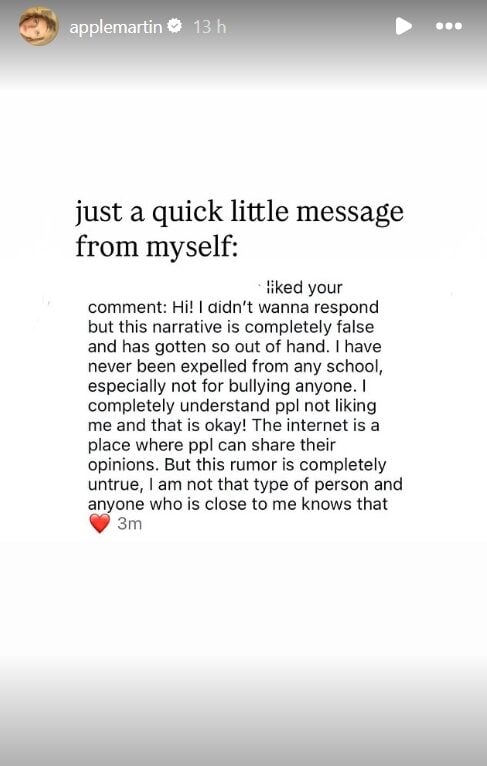
Nowadays, with viral whispers and screenshot culture, even the children of global celebrities are not immune to sudden waves of online speculation. This week, Apple Martin addressed a rumor circulating on social media that claimed she had been expelled from school over alleged bullying. Posting directly to her Instagram Story, she firmly rejected the narrative.
“Hi! I didn’t wanna respond, but this narrative is completely false and has gotten so out of hand,” she wrote. “I have never been expelled from any school, especially not for bullying anyone… this rumor is completely untrue.”
Her statement was brief but pointed, and notably mature in tone. She acknowledged that not everyone has to like her, adding, “The internet is a place where ppl can share their opinions.” But she drew a clear line between opinion and fabrication, emphasizing that anyone who truly knows her understands the claims are unfounded.
Who Is Apple Martin Beyond the Headlines?
Apple Martin was born in 2004 to Academy Award-winning actor Gwyneth Paltrow and Chris Martin, the frontman of Coldplay. Her unusual first name famously sparked media fascination at the time of her birth, setting the tone for the intense public scrutiny that would follow her childhood.
Unlike many celebrity children, Apple has largely been kept out of the spotlight by her parents. Paltrow and Chris Martin have consistently spoken about protecting their children’s privacy, even during their highly publicized “conscious uncoupling” in 2014.

While Apple has occasionally appeared at fashion events or on social media in recent years, including at Paris Fashion Week, where her appearances generated viral attention, she has not built a career dependent on public exposure. That context makes the sudden emergence of a damaging rumor especially notable.
The Anatomy of a Viral Rumor
There is no credible reporting from established outlets confirming that Apple Martin was expelled from any school. Nor are there public disciplinary records or school statements supporting the claim. The allegation appears to have spread primarily through anonymous social media posts and gossip-style commentary accounts.
This is increasingly common in the digital age. A single unverified post can snowball into widespread speculation within hours. Algorithms reward engagement, not accuracy, and allegations framed as “insider tea” often travel faster than denials.
Apple’s decision to respond directly is interesting in itself. Many public figures choose silence, hoping rumors fade. By addressing it head-on, she disrupted the rumor cycle. In doing so, she reframed the conversation around accountability and digital responsibility.
Celebrity Children and the Public Gaze

There is a broader cultural layer here. Apple Martin belongs to a generation of celebrity children coming of age in a far more invasive digital environment than previous cohorts.
In the early 2000s, tabloid magazines dominated gossip. Today, anyone with a smartphone can become a rumor amplifier. Celebrity offspring are often treated as public property, dissected, compared, and judged despite not choosing fame themselves.
What makes this case particularly sensitive is the nature of the allegation. Claims involving bullying or school discipline can follow a young person for years, shaping public perception regardless of their truthfulness. Even when denied, such rumors can leave a digital footprint that resurfaces later.
Apple’s message subtly highlighted this reality. She didn’t lash out. Instead, she emphasized character, stating she is “not that type of person” and that those close to her know that.
Why Do We Want These Stories to Be True?
One uncomfortable but important question lingers: why do rumors like this gain traction so quickly?
There’s a cultural appetite for narratives that humanize or destabilize the privileged. When someone grows up with extraordinary access, such as wealth, connections, or opportunity, audiences sometimes look for evidence that their life is not as polished as it appears.
It’s a phenomenon psychologists describe as “status correction.” The public often finds a strange comfort in stories that bring high-status individuals “down to earth.”
But there’s a difference between legitimate critique and inventing wrongdoing. Conflating the two risks normalizing defamation as entertainment.
Gwyneth Paltrow and the Public Narrative Machine

Apple’s mother, Gwyneth Paltrow, is no stranger to polarized public opinion. As the founder of lifestyle brand Goop, she has faced criticism, lawsuits, and viral backlash over controversial wellness claims. That history may indirectly shape how online audiences perceive her family.
However, conflating parental controversy with a child’s alleged behavior is a leap unsupported by evidence. Apple’s Instagram story implicitly pushed back against the guilt-by-association claim.
Her father, Chris Martin, has cultivated a public image centered on humility and optimism, often speaking about gratitude and personal growth in interviews. The contrast between the family’s public personas and the bullying rumor may be one reason the claim felt especially jarring to some observers.
The Silence of Institutions
Another notable element: there have been no statements from any school or official institution corroborating the expulsion claim. In cases of serious disciplinary action, particularly involving high-profile individuals, leaks or confirmations often surface through reputable journalists.
The absence of such reporting matters.
Responsible coverage requires distinguishing between viral claims and verified facts. As of now, there is no evidence substantiating the allegation Apple addressed.

A Broader Lesson in Media Literacy
This episode underscores a larger cultural need: media literacy. Younger audiences, especially, navigate a landscape where TikTok slides and anonymous “sources” can appear indistinguishable from journalism.
Apple Martin’s denial functions not only as personal defense but also as a reminder that virality does not equal validity. There’s also an interesting generational shift at play.
Previous celebrity children might have relied on publicists to issue formal statements. Apple used Instagram Stories: ephemeral, direct, unfiltered. That method aligns with Gen Z’s communication style: immediate clarification rather than press release diplomacy.
What Happens Next?

Most online rumors follow a predictable cycle: ignition, amplification, denial, and eventual fade-out. For this story to dissipate quickly, it depends less on Apple’s statement and more on whether gossip accounts choose to continue circulating it.
For now, the only verifiable element is her denial. She has stated clearly that she was never expelled and never bullied anyone.
That clarity is significant. And perhaps the more important takeaway isn’t the rumor itself, but the speed at which unverified narratives can define someone, even temporarily.
Apple Martin’s response reminds us that sometimes the most powerful statement is a simple one: this isn’t true.