A caller claiming to be a detention center sergeant told a South Carolina woman that her son had been jailed for cannabis possession and needed $850 for bail. She sent the money through Zelle, then learned from her son that the call was a scam.
Investigators later identified Kadrain Mitchell, 35, of Jonesboro, Georgia, as a suspect in the case.
Mitchell surrendered at North Charleston City Hall on October 19, 2026, and was charged with impersonating a police officer and breach of trust, according to the North Charleston Police Department. The agency published the arrest notice the following day.
The incident occurred months before the Charleston County Sheriff’s Office changed its online inmate-search system to protect families from fraudulent bail requests. Earlier scams involving people posing as detention employees had already cost local residents thousands of dollars.
A Caller Claiming to Be ‘Sgt. Daniels’ Said Her Son Needed Bail
The woman was visiting a pharmacy on November 30, 2025, when she received a phone call from someone identifying himself as “Sgt. Daniels” with the Charleston County Detention Center.
The caller instructed her to send the money to someone described as a bail bondsman in Greenville, South Carolina.
She reported the suspected scam to North Charleston police on December 4.
Police Linked the Zelle Payment to a Georgia Phone Number
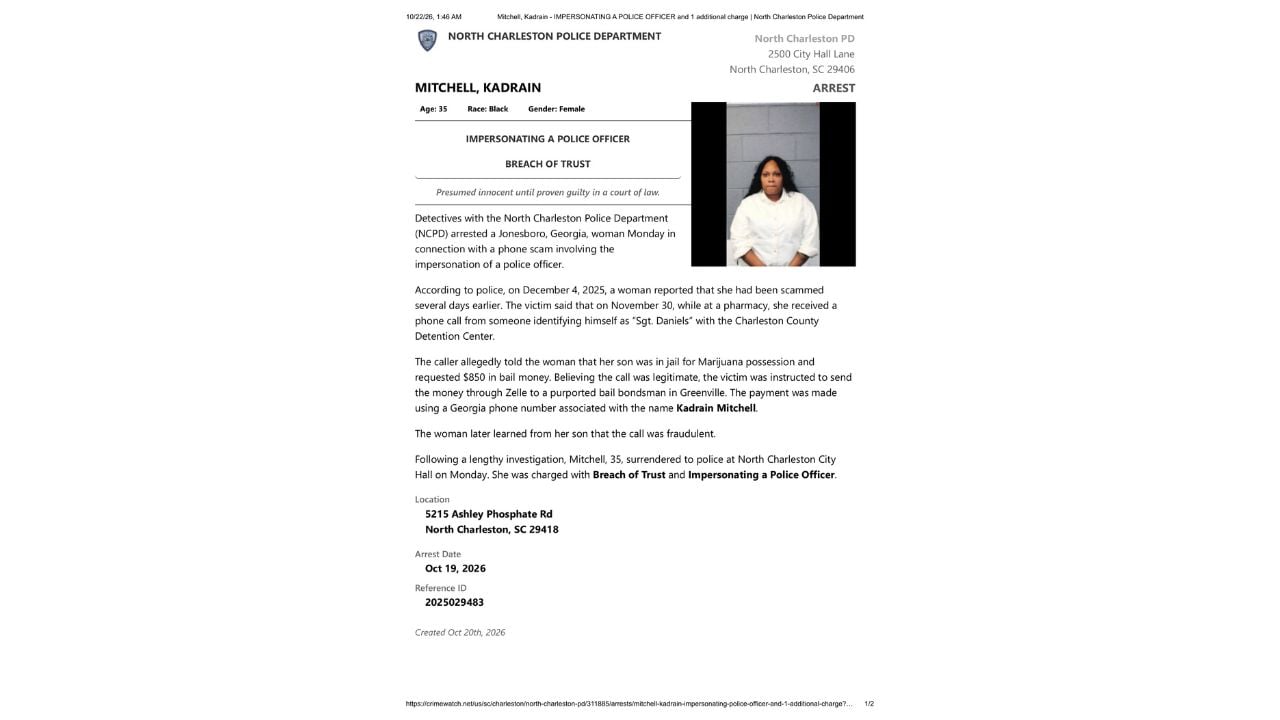
Detectives investigating the payment determined that it had been made using a Georgia phone number associated with Mitchell’s name, according to the department’s arrest announcement.
The department recorded the incident under reference number 2025029483. Mitchell is presumed innocent unless proven guilty in court.
Other Charleston County Families Had Paid Fake Jail Callers
Similar impersonation schemes had already been documented in the area. In November 2022, the Charleston County Sheriff’s Office warned that callers were posing as deputies and detention center employees to demand payments from families.
In three incidents described by the agency, one victim sent $1,500 through Cash App, another transferred $1,500 using Zelle, and a third paid $4,000 through Cash App and Venmo.
One caller claimed that an incarcerated relative was in danger, creating additional pressure to send money. Other impostors demanded payments over supposed warrants or missed jury duty.
Some of those targeted genuinely had family members in custody, making the impersonation more convincing. Other callers appeared to be guessing whether their targets knew someone who had recently been arrested.
The Sheriff’s Office Delayed Online Inmate Listings to Reduce Scams
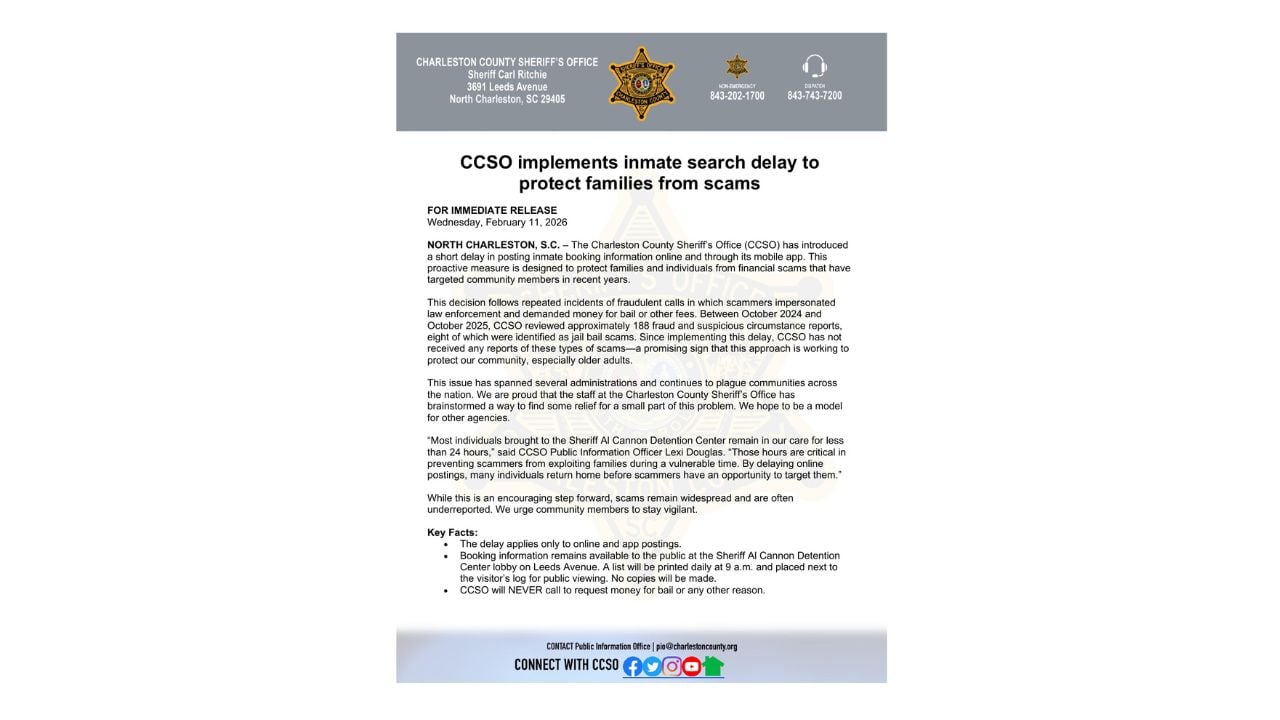
On February 11, 2026, the Charleston County Sheriff’s Office announced that it had introduced a delay before inmate booking information appeared on its website and mobile app.
The agency said it had reviewed approximately 188 fraud and suspicious-circumstance reports between October 2024 and October 2025, identifying eight as jail-bail scams.
Public Information Officer Lexi Douglas explained that most people brought to the Sheriff Al Cannon Detention Center remain there for less than 24 hours. Delaying online postings could allow some people to return home before scammers obtained the booking information needed to target their relatives.
The restriction did not eliminate public access to booking records. The sheriff’s office continued making a printed list available in the detention center lobby, updated daily at 9 a.m.
In its February announcement, the agency reported that it had received no new jail-bail scam complaints since introducing the delay.
How to Verify a Bail Request Before Sending Money
The Charleston County Sheriff’s Office says it never calls families to request money for bail or other fees. Anyone receiving such a demand should end the conversation and independently contact the sheriff’s office at 843-202-1700.
Charleston County’s Centralized Bond Hearing Court can also be contacted at 843-746-9822 to verify bond-related procedures rather than relying on payment instructions supplied by an unfamiliar caller.
Families should not send bail payments through a personal Zelle, Venmo or other payment account simply because someone claims to represent a law enforcement agency.
Anyone who has already transferred money should promptly contact their financial institution and report the transaction. Certain qualifying impostor scams may be eligible for reimbursement, although recovery is not guaranteed.
Victims should preserve the recipient’s phone number, payment confirmation, transaction ID, call history and related messages for their bank and police report.