
Kash Patel got one media outlet to back off. The Atlantic is doing the opposite.
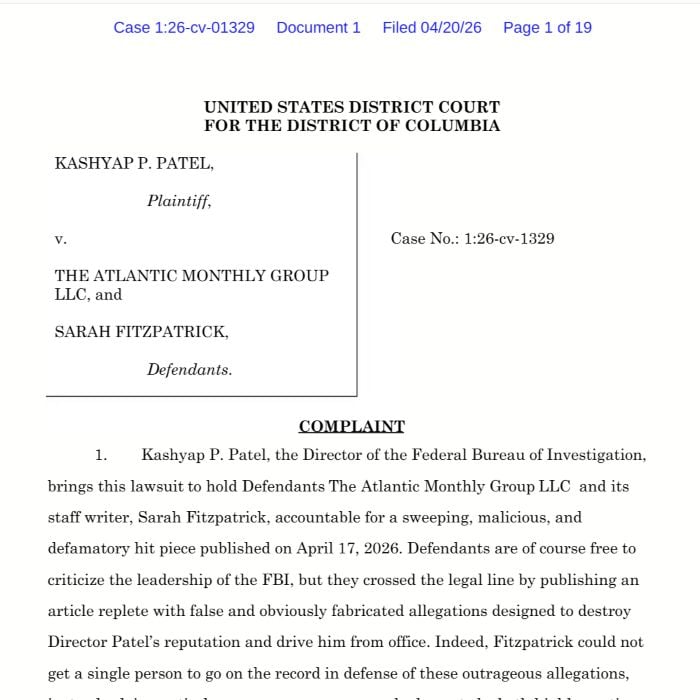
That is the real story inside the $250 million defamation lawsuit Patel filed Monday against The Atlantic and reporter Sarah Fitzpatrick in federal court in Washington. Not simply that the FBI director is suing over a story alleging excessive drinking and unexplained absences from headquarters. It is that Patel is trying the same intimidation play in a much harder arena, and this time, the other side is not backing up.
He practically wrote the entire setup himself. Before publication, according to both the article and his own complaint, he told the magazine: “Print it, all false, I’ll see you in court — bring your checkbook.” By Monday morning, he was the one writing the check request.
He got a correction from MSNBC. Not this time
In May 2025, MSNBC analyst Frank Figliuzzi said on Morning Joe that Patel had been “visible at nightclubs far more than he has been on the seventh floor of the Hoover Building.” A few days later, host Jonathan Lemire walked it back on air: “This was a misstatement. We have not verified that claim.” Patel still sued Figliuzzi — but the correction gave him something concrete to grab. A named claim, a public walk-back, a clear error to point to.
The Atlantic handed him nothing like that.
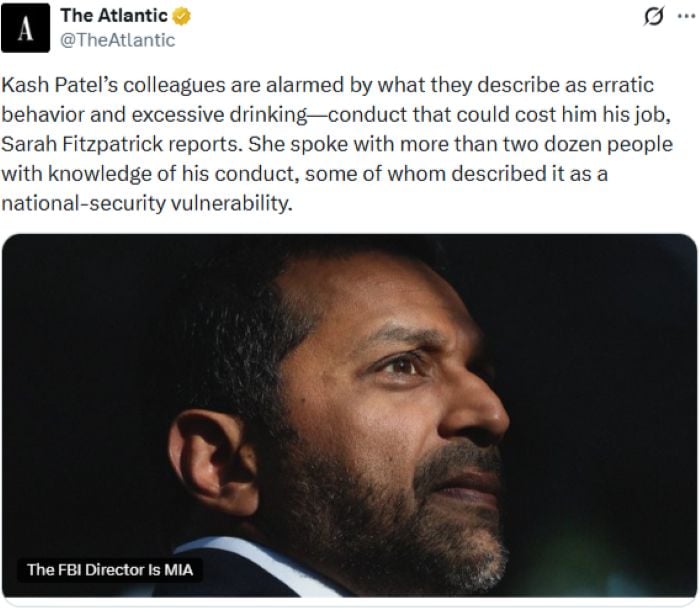
Fitzpatrick, whose story was built on interviews with more than two dozen people — current and former FBI officials, hospitality workers, members of Congress, lobbyists, and political operatives — said Friday night publicly: “I stand by every word of this reporting.” The Atlantic called the lawsuit meritless and said it would vigorously defend its reporting and its journalists. The magazine did change the headline after publication — from “Kash Patel’s Erratic Behavior Could Cost Him His Job” to “The FBI Director Is MIA.” Patel’s legal team treats that like an admission. It may just be a smarter headline.
Why the legal bar makes this harder than it sounds
Patel is not a private citizen blindsided by a random lie. He is the sitting FBI director. That means the Supreme Court’s 1964 ruling in New York Times v. Sullivan is the first thing waiting for him when this case starts to matter. Public officials must prove not just that a statement was false, but that the publisher acted with actual malice — meaning The Atlantic either knew the allegations were false or showed reckless disregard for whether they were. The standard exists specifically to protect aggressive investigative reporting on people who hold federal power.
Patel’s lawyers argue the magazine ignored detailed pre-publication denials and failed to take basic investigative steps that would have refuted the claims. They list 17 specific statements they call false and defamatory, including that he drinks to the point of obvious intoxication at Ned’s Club in Washington and the Poodle Room in Las Vegas, that his absences forced the FBI to reschedule time-sensitive briefings, and that his security detail once requested breaching equipment because he was unreachable behind locked doors.
Patel says none of it happened. The Atlantic says it has more than two dozen sources saying otherwise.
The lawyer, and the case before this one
Patel hired Jesse Binnall for this fight. That is worth noting.

Binnall most recently represented Mark Robinson, the former North Carolina lieutenant governor, when Robinson sued CNN over its reporting on posts on a pornography website that CNN tied to him. Robinson maintained CNN’s reporting was false. He later dropped the lawsuit. He subsequently acknowledged he had lied during his gubernatorial campaign and that there was some truth to the underlying allegations.
Patel’s case may have entirely different facts and a different outcome. But the lawyer bringing his “all false” claim against The Atlantic is the same lawyer who carried the last major “all false” media defamation war, which ended with the plaintiff walking away.
After the Call: S1. E1.
I admit it…..https://t.co/6OASfxKRU6 pic.twitter.com/Jok6LVu7Rx
— Mark Robinson (@markrobinsonNC) March 19, 2026
What the lawsuit is actually designed to do
The complaint does not publicly lay out a specific damages calculation for the $250 million ask. It is still a deliberately aggressive number. Discovery could still shake something loose — depositions from sources, internal editorial communications, evidence of what The Atlantic knew and when. Maybe that is the point. Maybe Patel thinks the lawsuit itself sends a message to the next newsroom, considering the next ugly story about the FBI director.
What he does not have, at least not yet, is the one thing he had with MSNBC: a walk-back.
The Atlantic has already brought its checkbook.