 Every article about making money recycling wood pallets makes the same promise.
Then you read it. The advice is so vague you couldn’t actually do it. No real numbers. No buyer contacts. No honest talk about what happens when half your haul is broken garbage.
I’ve been testing side hustles on MoneyPantry since 2013. When something sounds promising, I don’t just write about it. I do it.
So I did this one.
FreeCash: Get paid for testing games, using app & taking surveys. Highest Payouts, Instant Cashouts & Daily Bonuses. Sign up for free
Earn Haus: They’re paying up to $25 per survey—and you get paid the same day. PayPal, Venmo, or check. Get Paid Now
HealthyWage: Lose weight, win cash — HealthyWage pays up to $10,000 when you hit your goal. Start Now!
KingOpinion: People are getting paid up to $210 per survey, no joke. Take one and see for yourself. Join Free
Swagbucks: Over $900M paid out. Sign up now and grab $10 free—then earn more watching videos, taking surveys & more. Snag $10 Free
One Saturday morning, I loaded my Silverado at a shopping plaza five minutes from my house. Walmart. Schnucks. A few smaller stores. I asked the managers, loaded up 24 pallets, and drove them to the nearest local broker.
Mix of Grade A and Grade B. Total payout: $105. Gas: $25.
Net: $80 for about five hours of work.
Not life-changing. But it’s real. And I had zero experience before that morning.
Here’s what I’ll cover that other guides skip entirely: real pricing by pallet grade, exactly where to find buyers before you collect your first pallet, what to do with broken pallets, and what you’ll owe the IRS, because nobody else talks about that part.
What you can realistically make:
- Part-time collectors running 2 to 3 days a week typically net $220 to $370 after gas.
- Serious operators running 4 to 5 days can net $550 to $900. Your first run will be lower. Expect $50 to $150 while you build your routes.
That’s the honest version.
Is Wood Pallet Recycling Actually Worth Your Time?
Let’s be honest.
This is physical work. You’re loading and unloading heavy wooden pallets. You need a truck. And your income depends a lot on where you live.
But here’s what makes recycling wood pallets different from most side hustles.
The supply is basically unlimited. The U.S. uses around 2 billion pallets every year. According to research from Virginia Tech, wooden pallets get recycled or reused at a rate of about 95%. That means there’s a whole industry built around collecting, fixing, and redistributing them.
You’re just one piece of that system.
The idea is simple. You pick up pallets businesses don’t want. You sell them to businesses that do. The money you make is the gap between “free” and what buyers pay you.
This works best if you:
- Live in or near a city with factories, warehouses, or lots of retail
- Have a pickup truck, or can rent one cheaply
- Can put in 5 to 15 hours a week
- Are okay with physical, outdoor work
It’s probably not worth your time if:
- You’re in a rural area with few nearby businesses
- You have no vehicle and no budget to rent one
- You’re expecting big money in week one
Give it four to eight weeks to build up. That’s when the real money starts showing up.
How Much Money Can You Make Recycling Wood Pallets?
This is where most articles lie to you.
They throw out numbers with zero math behind them. So let’s actually break it down.
Pallet Prices by Grade
Not all pallets pay the same. Condition is everything.
The standard size is 48×40 inches. It’s called a GMA pallet. This is the one buyers always want.
Other sizes are harder to move, so call your buyer before collecting anything non-standard.
|
Grade |
Condition |
2026 Price |
|---|---|---|
|
Grade A |
Like new, minimal repairs |
$6-$8 each (up 15% from 2025 amid lumber inflation) |
|
Grade B |
Functional, some wear |
$4.25-$5.50 each (steady from late 2025) |
|
Core (damaged) |
Broken boards |
$1.50-$2.00 each (regional variation high) |
|
Scrap |
Beyond repair |
$0-$0.50 (mulch operations paying slightly more) |
Regional prices can go much higher.
One reader in Arizona said their buyer pays $10 to $12 per pallet. California coastal areas and the Northeast can pay 20-25% above national averages. Rural states like Arkansas and Mississippi pay less.
Check Repackify’s price index for real-time transaction data in your area, as lumber tariffs and supply chain adjustments are creating weekly price swings.
What You Can Realistically Make Per Week
|
Effort Level |
Pallets/Week |
Gross |
Gas |
Net |
|---|---|---|---|---|
|
Casual (weekends) |
40-60 |
$120-$180 |
$30-$45 |
$75-$150 |
|
Part-time (2-3 days) |
100-150 |
$350-$525 |
$70-$90 |
$260-$435 |
|
Serious (4-5 days) |
200-300 |
$850-$1,200 |
$140-$170 |
$680-$1,030 |
These numbers reflect current 2026 pricing with Grade A pallets averaging $7 and Grade B averaging $4.75. Your actual results depend heavily on local supply sources and buyer relationships.
I tested this a while back. I have a black Chevy Silverado truck, so that helped. There’s a huge shopping plaza 5 minutes from me with Walmart, Schnucks, and a few other local stores.
One Saturday morning, I went there and asked the store managers. I collected 24 pallets. Then I found the closest local broker near me and sold the pallets same day.
The mix was mostly Grade B with a few Grade A. Total payout: $105. Gas: $25. Net: $80 for about five hours.
Note: this was a while back when prices were lower.
Not huge. But $80 for a Saturday morning with zero experience?
That’s decent money for a few hours of work, no?

What You Need to Get Started
You don’t need much.
Here’s the real list:
- A truck or trailer: This is the main one. A standard pickup bed holds 10 to 15 pallets. A truck with high side rails holds more, which means fewer trips and less gas.
- Cargo straps: Not optional. Pallets falling from a moving vehicle have caused serious accidents. Strap every load.
- Thick work gloves: Leather, not garden gloves. Splinters and nails are constant. Budget around $15.
- A drill and nails: For fixing Grade B pallets to Grade A condition. I’ll explain why this matters in a minute.
If you already own a truck, you can start for under $50.
No truck? You can rent from Fetch or U-Haul. A pickup truck rental runs around $20 a day plus mileage and gas. If you net $120 on a Saturday run, a $40 rental still leaves you $80 ahead.
Do You Need a License?
At the side hustle level, no.
You’re a sole proprietor. No special business registration required to start.
If you scale up to a warehouse or hire people, permits and insurance kick in. But at the “Saturday truck run” stage, you’re fine.
Where to Find Free Wood Pallets
Here’s what surprised me when I first looked into this.
Finding pallets is actually the easy part.
Any business that receives large shipments has pallets stacking up. Most of them have no system for dealing with empties. They pile up. They take space. They become a problem.
You’re solving their problem while solving yours.
The Best Business Types to Approach
These are your best sources:
- Manufacturing and distribution companies: highest volume, most consistent supply
- Grocery stores and supermarkets: daily deliveries, constant turnover
- Home improvement stores (Home Depot, Lowe’s): large pallets, frequent restocking
- Furniture retailers: often have oversized pallets
- Garden centers and nurseries: great in spring and summer
- Restaurants and food distributors: lower volume per stop but widespread
- Convenience stores: what larger pallet companies need help covering
How to approach: go in person. Ask for the manager. Tell them you’d like to take their pallets off their hands on a regular schedule, for free. Offer to come on a specific day each week.
Most managers say yes within 30 seconds. You’re solving a storage problem they didn’t know how to fix.
Pro tip: ask how often they get new pallets. That tells you pickup frequency and whether the account is worth adding to your regular route.
Online Sources
- Craigslist “Free” section: search your city for “pallets.” New listings go up daily.
- Facebook Marketplace: search “free pallets” or “wood pallets.” Very active in most metro areas.
- Repalletize.com: free marketplace where businesses list excess pallets. Free to sign up.
Check out my guide for a list of the best places to find free pallets near you.
One Rule You Can’t Ignore
Always ask before you take.
Pallets sitting outside a business are still that business’s property. Taking them without permission can create legal problems.
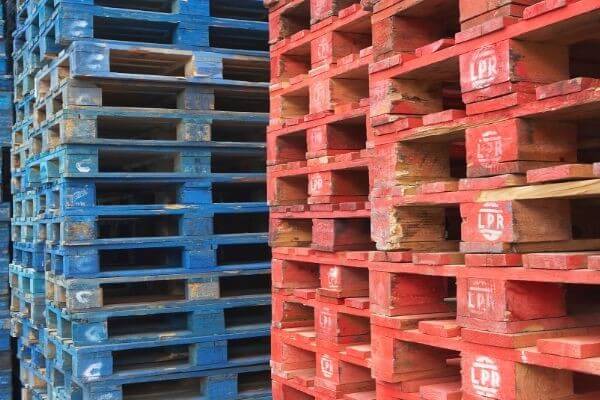
Also never take blue CHEP pallets or red PECO pallets. Those belong to pallet pooling companies and are tracked. Taking them is theft.
The businesses that want to get rid of pallets will tell you yes. Takes 30 seconds to ask.
How to Read Pallet Stamps
This section could save your health.
Every pallet used in international trade carries an IPPC stamp. That stamp tells you exactly how the pallet was treated before it entered the supply chain.
Here’s what the codes mean:

|
Stamp Code |
Meaning |
Safe? |
|---|---|---|
|
HT |
Heat Treated (kiln-dried at 140°F for 30+ minutes) |
Yes, this is what you want |
|
MB |
Methyl Bromide (fumigated with toxic pesticide) |
No, avoid completely |
|
DB |
Debarked only (no pest treatment) |
Generally fine for resale |
|
No stamp |
Unknown treatment history |
Use caution |
HT pallets are the gold standard. Safe to sell, safe to use for furniture or garden projects. Buyers prefer them.
MB pallets are the ones to avoid. Don’t burn them. Don’t use them in vegetable gardens. Don’t build furniture from them for indoor use. The chemical residue is serious. Some buyers won’t accept them at all.
If a pallet has no legible stamp, assume you don’t know its history and price it lower.
This one piece of knowledge puts you ahead of most new collectors.
Where to Sell Your Wood Pallets for the Most Money
Here’s the thing nobody tells you.
Finding pallets is easy. Finding buyers is the hard part.
I’ve published articles about pallet recycling before. The most common question in the comments wasn’t “where do I find pallets.” It was “where do I find buyers in my area.” People from Florida, South Carolina, New Jersey, Vegas, all asking the same thing.
So here’s the smart move: find your buyer before you collect your first pallet.
Pallet Brokers (Your Most Reliable Buyers)
Pallet brokers are middlemen. They buy from collectors like you, fix and sort the pallets, then resell to manufacturers. They’re consistent, they pay on delivery (usually cash), and they’re your easiest option.
National broker networks:
- Kamps Pallets: over 400 locations across the U.S., use their location finder to find one near you
- 48 Forty Solutions: 73 company-owned plants nationwide, call 1-877-779-8577
- Wiley Pallet: regional coverage in many metro areas
To find more brokers in your area, use the North American Pallet Recycling Network. It’s a free directory that matches pallet sellers with buyers.
Also check the NWPCA directory. It lists member companies that buy and sell pallets.
Call a few brokers, tell them what you can supply, and ask what they pay.
Most brokers pay on delivery so you don’t have to wait around. You just drop off the pallets and get paid instantly.
Selling Direct to Manufacturers
Cutting out the broker means more money per pallet.
Instead of $3 to $4 from a broker for Grade B, a manufacturer might pay $5 to $7 for Grade A. But this requires consistent volume, reliability, and some sales work upfront.
Start with brokers. Prove you can supply consistently. Then approach manufacturers directly as you scale.
Online Marketplaces
- Repalletize: free to sign up, good for standard and non-standard sizes
- Verde Trader: another platform for buying and selling used pallets
- Facebook Marketplace and Craigslist: great for selling to individuals. Higher per-pallet prices, lower volume.
How to Repair Pallets and Increase What You Earn
This is basically free money.
Upgrading a pallet from Grade B to Grade A takes about five minutes and maybe $0.25 in nails. If Grade B pays $4 and Grade A pays $6, that’s $2 extra per pallet. Do that to 20 pallets and you just made an extra $40 without collecting a single extra pallet.
Here’s the thing about pallet wood. Most of it is hard-seasoned oak. You can’t just hammer nails straight in. The wood splits. Drill pilot holes first, then nail or screw.
What Grade B needs to become Grade A:
- Replace any missing or cracked boards
- Hammer down any nails poking up
- Check the stringers (the side rails). A seriously cracked stringer is harder to fix.
When not to bother: if a pallet needs three or more board replacements, do the math. At 10 minutes of work, the money may not justify it. Sell it as a core ($1.50) or bring it to a mulch operation.
Lisa from Temecula, California commented on my original article. She runs an animal rescue and sells pallets as a side revenue stream at $4 each. She moves hundreds per month. Her insight: buyers who know you’ll bring consistent, sorted inventory will pay more reliably than buyers picking through a mixed load.
Sorting and basic repair builds your reputation fast.
The Upcycling Path
Wholesale flipping is about volume. Upcycling is about margin.
Instead of earning $2 to $6 per whole pallet, you turn one pallet into something worth $40 to $150.
What Actually Sells
From the research I have done and also looking at the current trends, these are the kind of stuff that sell consistently on Etsy and Facebook Marketplace:
- Outdoor furniture: coffee tables, benches, Adirondack chairs. Biggest demand, especially spring through fall.
- Wine racks and bottle holders: quick to build, people love them
- Decorative wall panels: rustic home decor stays popular
- Birdhouses and garden planters: easy entry-level builds
- Personalized wooden signs: add a wood burner and the price doubles
- Storage shelves and crates: steady demand year-round
Where to Sell What You Make
Facebook Marketplace works best for bulky furniture. No shipping, local cash pickup, fast transactions.
Etsy is better for smaller, shippable items. Takes time to build, but established shops can make real money. New Etsy sellers average around $2,200 in revenue their first year. Shops with two or more years often earn way more.
Local craft fairs and farmers markets give you direct cash and immediate customer feedback. Good for testing what sells in your area.
Consignment in local home decor shops is less work than managing your own shop. Worth exploring if you have a good local market.
Which Path Makes More Money?
Here’s the real comparison.
- Wholesale flipping: 50 pallets sold at $3 average = $150. Takes about 2 hours of collecting and delivering.
- Upcycling: 50 pallets turned into 5 coffee tables at $75 each = $375. Takes roughly 15 hours including building, sanding, and selling.
The math depends on how you value your time.
One of our readers (Carla from Portland) who commented on the original guide said she doesn’t bother with wholesale at all. She collects free pallets, builds outdoor furniture in her garage, and sells on Facebook Marketplace. She moves 6 to 8 pieces a month at $65 to $95 each. That’s $390 to $760 a month for roughly 20 to 25 hours of work. Better hourly rate than wholesale, but slower and it needs more space and skill.
Best strategy: start with wholesale to get cash flowing and learn the pallet market. Add upcycling later as a higher-margin second stream once you know which pallets are worth keeping.
Starting Without a Truck
Not having a truck is the most common reason people don’t start.
It’s also a solvable problem.
- Rent from U-Haul: Pickup truck rentals typically run around $19.95 per day base, plus mileage and gas. Do the math before you book. If you expect to net $120 on a Saturday run, a $40 to $50 rental still leaves you $70 to $80 ahead.
- Rent from Home Depot or Lowe’s: Both stores rent pickup trucks by the hour. Usually around $19 for the first 75 minutes, then cheaper per hour after that. Good for short local runs.
- Borrow from someone: Offer whoever lends you their truck a cut of the day’s earnings. 10 to 15% is fair and keeps the relationship solid.
The math on renting only works if you’re moving enough pallets to cover the rental cost and still profit. On your first run, you might not break even. That’s fine. Treat week one as paid market research so you can learn which businesses have good supply and which buyers pay the best rates.
Once you’re consistently moving 80 to 100 pallets a week, buying a used truck starts to make financial sense. Until then, rent.
One practical note: a truck with a topper or high side rails fits way more pallets per trip. Fewer trips means less gas and better margins. Worth factoring into your rental choice.
Taxes on Pallet Income
Let’s be real about this.
A lot of people doing pallet runs get paid in cash. Same-day, under the table, no paperwork. That’s just how a lot of brokers work at the small collector level.
I’m not here to tell you what to do. But here’s what you need to know if you’re doing this as more than occasional pocket money.
When the IRS Actually Cares
If you’re making a few hundred bucks here and there on random Saturdays, realistically nobody’s tracking that.
But if you’re doing this regularly and the money starts adding up, or if you want to turn this into a real side business, the tax stuff matters.
The IRS says any net self-employment income over $400 per year requires you to file Schedule C with your tax return. That’s the form for business income.
You also owe self-employment tax of 15.3% on top of regular income tax. That’s 12.4% for Social Security and 2.9% for Medicare. You’re paying both sides since you don’t have an employer.
Your state may also tax self-employment income separately, so check your state’s rules
David, one of the readers who commented on my original pallet guide, learned this the hard way. He netted $9,200 his first year doing pallet runs. Thought cash meant tax-free. Come April, he owed $1,407 in self-employment tax plus $612 in federal income tax. A $2,019 bill he wasn’t ready for.
He also missed tracking his miles. That cost him roughly $4,000 in deductions he could have taken.
If you’re making real money at this, talk to a tax preparer. A one-time consultation runs $100 to $200 and can save you way more than that.
The Deductions That Actually Help
If you do report the income, you get to deduct every legitimate business expense.
The biggest one is mileage. The IRS standard rate is 72.5 cents per mile for 2026 (verify current rate at irs.gov for the current year, before filing). If you drive 200 miles a week on pallet runs, that’s $145 per week in deductions. Over a year, that’s almost $7,540.
Track every business mile. Free apps like MileIQ work fine, or just keep a simple note on your phone.
Other stuff you can deduct:
- Nails, screws, replacement boards
- Gloves and safety gear
- Business use percentage of your phone
- Gas (if you’re not using the mileage deduction)
- Storage unit rental if you’re keeping inventory
Keep receipts for everything. A basic spreadsheet is enough.
The Bottom Line
If you’re doing this casually for beer money, you’re probably fine.
If you’re doing this consistently and making real money, or if you want to scale it into an actual business, set aside 25 to 30% of what you make and handle the taxes properly. It protects you and lets you take the deductions that actually lower what you owe.
More info at the IRS Self-Employed Tax Center.
Pros and Cons of Pallet Recycling
Here’s what’s good and what’s not so good about this side hustle.
|
Pros |
Cons |
|---|---|
|
Low startup cost (under $50 if you have a truck) |
Requires a truck or rental cost cuts into profit |
|
Paid same day, usually cash |
Physical work (loading, stacking, unloading) |
|
Set your own schedule |
Income varies a lot by city and market size |
|
Supply is genuinely unlimited |
Broken pallets are nearly worthless without repair |
|
Environmental upside (keeps wood out of landfills) |
Gas is your biggest ongoing expense |
|
Can grow into a full business with established routes |
Rural areas are much harder markets |
|
Strong tax deductions if you report the income |
SE tax (15.3%) catches people off guard if they report it |
Frequently Asked Questions
How much can you realistically make recycling wood pallets?
Part-time collectors moving 100 to 150 pallets a week typically net $220 to $370 after gas. Serious operators running 200 to 300 pallets a week can net $550 to $900. Week one will be lower than those numbers while you build your supply and buyer relationships. Expect $50 to $150 net on your first run.
Is it legal to take pallets from behind stores?
Not without asking first. Pallets sitting outside a business still belong to that business. Always get permission from the manager. Most will say yes. Never take blue CHEP pallets or red PECO pallets. Those belong to pallet pooling companies and taking them can get you in legal trouble.
What pallets should I avoid?
Look for the HT (Heat Treated) stamp. That’s what you want. Safe, in demand, and buyers prefer them. Avoid MB (Methyl Bromide) pallets completely. They’ve been treated with toxic pesticide. Don’t burn them, don’t build furniture from them, and don’t use them in vegetable gardens. Many buyers won’t take them.
Do I need a truck to start?
A truck makes everything way easier. But you can start by renting from U-Haul or Home Depot. Do the math before you book. Rental cost plus gas needs to be less than what you expect to net on the run. Once you’re consistently moving 80+ pallets a week, buying a used truck starts to make financial sense.
Where can I find pallet buyers near me?
Use the North American Pallet Recycling Network to find pallet brokers by zip code. Also check Repalletize.com (free to list and sell). Call local manufacturing companies directly. Facebook Marketplace works for selling to individuals who want pallets for DIY projects.
Do I have to pay taxes on pallet income?
Technically, if you net more than $400 per year from self-employment, you’re supposed to file Schedule C with your federal return. You’d also owe self-employment tax (15.3%) on net profit. The upside: mileage, repairs, supplies, and equipment are all deductible. If you’re doing this regularly and making real money, set aside 25 to 30% and handle it properly.
What size pallets are worth the most?
The 48×40 inch GMA pallet. It’s the industry standard. Most local buyers will always accept it and pay the best rates. Sizes like 48×48 and 42×42 have some value, but call your buyer before collecting them. Non-standard sizes can be hard to move locally.
Can pallet recycling become a full-time business?
Yes. People do it. But getting there requires multiple supply accounts, direct manufacturer relationships, consistent volume, reliable transport, and eventually some storage space. The jump from side hustle to full-time usually means moving from broker sales to direct buyer relationships and running your own route operation.
Is Wood Pallet Recycling Right for You?
I’ve published guides about pallet recycling before on MoneyPantry. Since then, I’ve heard from readers in Florida, New Jersey, Arizona, California, and all over.
Some are struggling to find local buyers. Some are quietly making serious money with established routes.
The gap between those two outcomes almost always comes down to one thing: finding your buyer before you collect your first pallet.
That’s the move.
Spend 30 minutes this week identifying three or four local businesses that might supply pallets. Then find one local broker or buyer using the North American Pallet Recycling Network. Then do one test run.
If you make $50 to $100 on your first half-day, the model works in your market. Scale from there.
It’s not glamorous. It’s not passive. But it’s real, repeatable income. And there are pallets waiting behind a business near you right now.
Have you tried selling pallets in your area? What did your first run look like? Please leave a comment blow. I would love to hear about your personal experience of selling or recycling pallets for money.