Erika Kirk has spent five months building a public identity around grief, faith, and devotion to her late husband. On Thursday, a former actress and investigative journalist named Elizabeth Lane posted a character analysis on X calling it all a performance — and nearly 6 million people viewed it within 24 hours.
The post drew 5.9 million views, 36,000 likes, 6,500 reposts, and 10,000 bookmarks. It didn’t break news. It didn’t cite anonymous sources. What it did was put a name on something millions of people had apparently been feeling since September but couldn’t quite articulate — a lingering, hard-to-define discomfort with what they were watching.
Lane, who serves as COO of streaming platform UNIFYD TV, wrote that she finds Kirk “deeply disturbing — not because of rumors or gossip, but because of consistent, observable patterns of behavior.” She emphasized that her post was opinion, not a clinical assessment — but her conclusion was pointed: she believes Kirk may be a psychopath. Referencing psychologist Robert Hare’s research on psychopathy, Lane suggested that what some viewers perceive in Kirk’s public appearances — rehearsed emotional displays and abrupt tonal shifts — resembles traits discussed in psychological literature.
I’m going to be blunt. I’ve reached the point where I find Erika Kirk deeply disturbing, not because of rumors or gossip, but because of consistent, observable patterns of behavior. To be clear, everything I say in this post is my opinion, I’m not claiming this is a fact I’m… pic.twitter.com/qheCjcjNwx
— ELIZABETH LANE (@imelizabethlane) February 13, 2026
Lane is not a licensed clinician, and her post did not constitute a formal diagnosis. But her central claim was pointed: “What people struggle to watch,” she wrote, “is not grief. It’s the absence of emotional continuity.”
Candace Owens reposted the thread within hours, calling it a “MUST READ” and writing that “every single word of this is accurate.” Laura Loomer pushed back, defending Kirk and suggesting the post said more about Owens than the TPUSA CEO.
Five months of ‘something feels off’
The debate over Erika Kirk’s authenticity has been the background noise of conservative media since September 10, 2025 — the day her husband, 31-year-old TPUSA founder Charlie Kirk, was shot and killed at Utah Valley University. What Lane’s post appears to have done is serve as a release valve — a single framework for five months of moments that individually sparked the same uneasy reaction without ever producing a definitive answer for why.
It started eight days after Charlie’s death, when TPUSA’s board unanimously elected Erika as CEO and board chair, stating that Charlie had previously expressed this wish. For some observers, the speed of the transition was striking: the woman who had publicly talked about “submitting” to her husband and called “boss babe culture antithetical to the Gospel” was now running one of the most influential conservative organizations in the country. Lane later described the rapid adaptation as notable, writing that such a shift is “quite impressive for a usual person but not for a psychopath.” Supporters countered that stepping into leadership during crisis is not inherently suspicious — particularly if it reflected Charlie’s stated intentions.
The Zoom call that drew scrutiny
I don’t care what anyone says. For Erika Kirk to be behaving like this after only 11 days since Charlie was assassinated is fucked up!
This isn’t grieving. She’s not sad or heartbroken at all, it’s just fucking weird behaviour!
— JonnyUtd (@Fx1Jonny) January 29, 2026
Then came the leaked audio. Six days after the assassination, Kirk held a staff Zoom call in which she discussed 275,000 memorial attendees and more than 200,000 in merchandise sales, calling it “an event of the century.” The audio, leaked by Owens in January 2026 and reported by Parade and BuzzFeed, drew immediate backlash.
Owens called the tone and laughter “off-putting.” One commenter on X wrote: “That is the first time she sounds authentic — being happy about merch at the memorial of her husband.” Others defended Kirk, saying she was thanking staff during an extraordinary and emotionally chaotic period — an impossible moment with no script for how to behave.
The moments that kept piling up
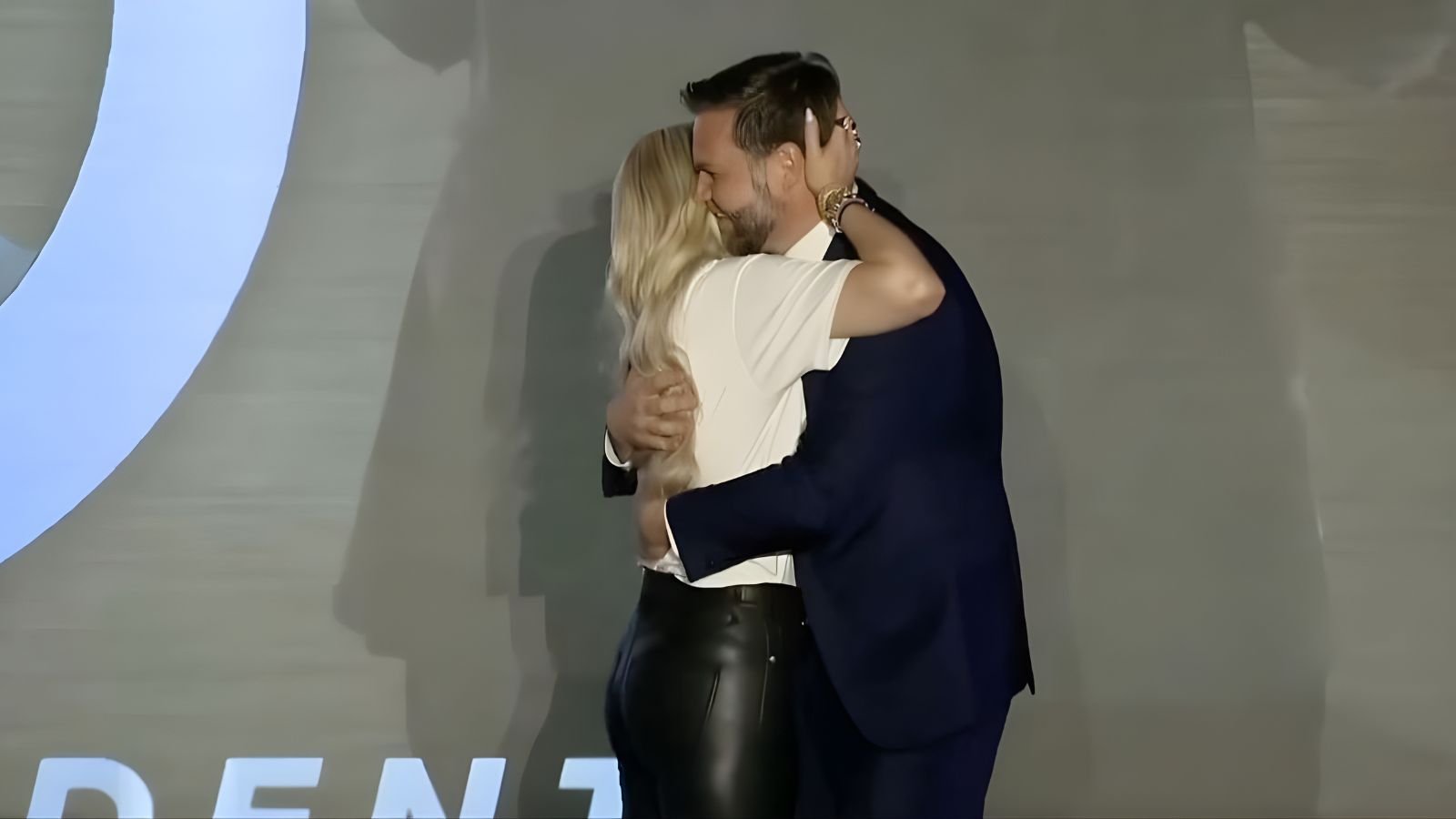
The scrutiny didn’t slow down. In October, video footage of Kirk sharing an extended embrace with Vice President JD Vance at a TPUSA event went viral — her hand on the back of his head, his hands on her waist. She later told Megyn Kelly that “my love language is touch.” A lip reader claimed she had whispered, “It’s not gonna bring him back,” though lip-reading interpretations are inherently imprecise.
In November, a backstage clip appeared to show Kirk touching her eyes before walking on stage. Critics called it staged tears; supporters said she was wiping makeup. John Cleese shared the clip with a quote attributed to George Burns: “Sincerity is the key. If you can fake that, the sky’s the limit.”
Each moment, in isolation, fueled debate. None provided definitive proof of intent.
The quiet changes people noticed
People noticed that Erika Kirk has removed the wedding photo with Charlie Kirk from his bookshelf 😬 pic.twitter.com/Qt3kgTDUlw
— kira 👾 (@kirawontmiss) February 11, 2026
In February, unverified side-by-side screenshots from Charlie’s home office went viral after viewers noticed Kirk had apparently removed their wedding photo from a prominent shelf and was no longer wearing her ring. A TPUSA spokesperson told Newsweek the photo had been relocated so their daughter could hold it.
Days later, Kirk was notably absent from TPUSA’s “All-American Halftime Show” — the organization’s biggest event since Charlie’s death — despite having told Fox News that Charlie “would be fist-pumping at this.”
Online speculation continued — without conclusive evidence in either direction.
Why 6 million people said ‘yes, that’s it’
NEVER FORGET when Erika Kirk was caught using tear solution to create fake tears before going on the TPUSA stage.
A freak show. pic.twitter.com/xtAjxUieoB
— Parody Jeff (@BackupJeffx) January 27, 2026
Elizabeth Lane’s post didn’t introduce any of these moments. All of them had already been covered, debated, and argued over individually. What the post did was stack them together and offer a framework — what might be called the uncanny valley of manufactured emotion, the discomfort people describe when something appears almost, but not entirely, genuine.
Whether that framework is fair is a separate question. Lane acknowledged her post was opinion, not fact. Critics argue that labeling public figures with psychological terminology based on media appearances risks real harm. Grief is unpredictable. Public scrutiny distorts behavior. A widow under constant surveillance may never look “right” to an audience that has already decided what grief should look like.
But the engagement numbers tell their own story. For five months, millions of people watched Erika Kirk and felt a discomfort they couldn’t name. Lane gave them a framework, and 6 million of them decided it fit.
Kirk has not publicly responded to Lane’s post.