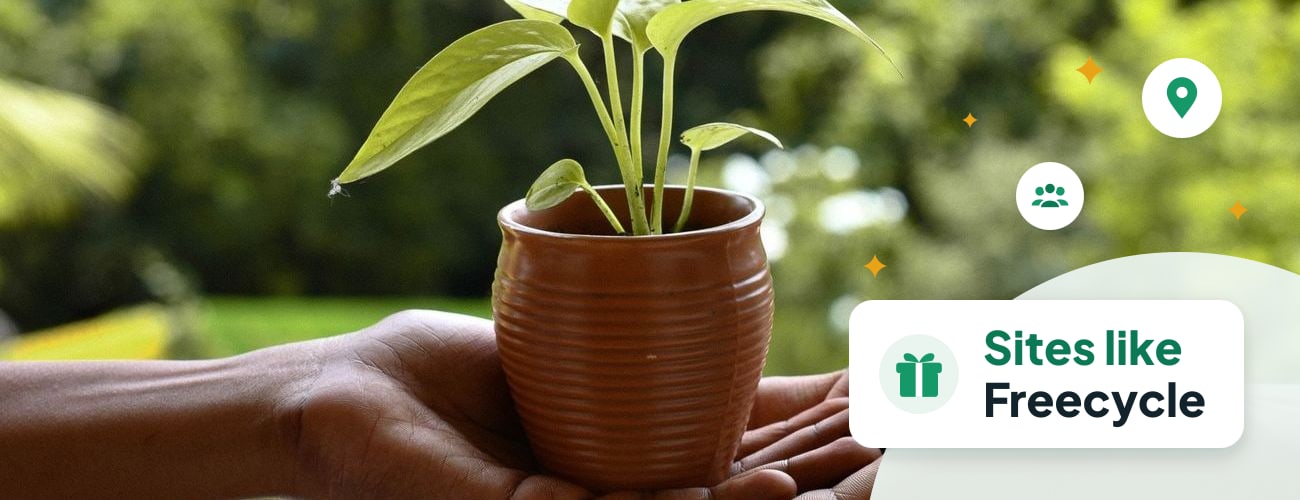
Americans threw out 12.1 million tons of furniture in 2018, 80% of it to landfill, the EPA says. The sites like Freecycle below pass things on instead: gift groups, marketplaces with $0 listings, and apps for food and books. Each shows how it differs, its numbers and what people found using it.
Key takeaways
- Freecycle: 12.3 million members in 5,333 towns, but its count barely moved from 2012 to 2020, and no-shows top its newest Trustpilot reviews.
- Best gift group: Buy Nothing claims 14 million members and 8,000 Facebook groups. Its app rates 2.1 on Google Play, so start with your local group.
- Not the same thing: Trash Nothing’s app is named “Trash Nothing + Freecycle”, but Freecycle says freecycle.org posts don’t appear in it.
- Most listings: Facebook Marketplace lists 430 million items a month worldwide. In one day of free pickups, a YouTuber collected about $460 of goods.
- Dead ends: Listia, Yerdle, Swaptree and Freesharing.org are gone or changed, and Freegle and Geev serve only the UK and France.
- Safety: meet in public, and never share a verification code. Craigslist calls a request for one “always a scam”.
Why People Look Beyond Freecycle
Freecycle began on May 1, 2003, when Deron Beal emailed 30 or 40 friends and a few nonprofits in Tucson, Arizona. It is a 501(c)(3) charity whose town groups are run by volunteer moderators, and its guidelines say everything posted must be free, legal and appropriate for all ages, with no swaps and no money, not even for shipping.
Its homepage counted 12,316,762 members in 5,333 local towns on October 12, 2026. That is nearly three times the 4.3 million of January 2008, but the count barely moved for most of the 2010s: 8.9 million in January 2012, 9.2 million in January 2020, with a dip to 6.8 million in January 2014 that Freecycle’s homepage doesn’t explain.

For years most Freecycle groups ran on Yahoo Groups, the court record shows, and the network split more than once. Many UK groups left in 2009 to form Freegle, LetsRecycle reported. In 2010 a federal appeals court ruled that Freecycle had abandoned its trademarks as against a Sunnyvale, California, group it had let use them without supervision.
For most of its life Freecycle had no app of its own: its help centre still said so in July 2025. Its official iPhone app came out in July 2026, and in October 2026 the app showed two ratings on the App Store and 5,000+ downloads on Google Play.

Freecycle still works where its town group is busy. The sites below reach more people, offer better apps, or specialise in food or books, and nothing stops you using several at once.
Bottom line: keep your Freecycle account if your town is active, and add one gift group and one marketplace to widen your search.
Sites Like Freecycle at a Glance
All eight are free to join and use for giving and getting. The sizes are each company’s own figures, and they count different things, so read them as rough scale, not a ranking.
The apps differ more than the sites. On Google Play, the big marketplaces rate 4.4 to 4.7, while the gift-only apps rate 2.1 to 3.9, each from far fewer reviews.

Apple’s App Store gives a kinder average to BuyNothing, 4.3 from 2,077 ratings. Its newest reviews are harsher, as the Buy Nothing entry below shows.
8 Sites Like Freecycle for Free Stuff Near You
Buy Nothing
Buy Nothing is the closest thing to Freecycle, with one difference: you can also ask, borrow and lend, and thank givers in public. Its rules say “No buying, selling, bartering, trading”. The first group started on Facebook in July 2013 on Bainbridge Island, Washington, and the project claims 14 million members in over 50 countries and 8,000 Facebook groups.
There are two ways in. A local Facebook group uses your personal profile and its volunteer admins’ local rules. The app, released in June 2021, keeps your home address private and shows Gives and Asks within a radius you choose; you must be 18 or older.
Standard membership is free. A paid Pro tier adds saved locations, a radius of up to 100 miles, alerts and post bumps; it cost $54.99 a year or $5.49 a month in November 2025, The San Francisco Standard reported. Buy Nothing also has no universal one-group rule, though some groups set one.
The app is the weak spot. It rates 2.1 on Google Play, and 39 of the 50 newest reviews on its US App Store page, from February to October 2026, gave one or two stars, mostly over bugs after a redesign and over logins. Four were about the paywall, such as needing Pro to limit posts by distance.

Groups have their own trouble. DCist found Washington-area members removed or banned for suggesting a sale or a place to donate, and in October 2025 Facebook took down an unregistered 116,000-member San Francisco group over the Buy Nothing name; it returned renamed a week later. Buy Nothing says it has no plan to close registered groups.
Worth it? Yes. Start with your local Facebook group, where Buy Nothing began, and use the app if you’d rather avoid Facebook. Skip Pro unless you live somewhere rural and need a wider radius.
Trash Nothing
Trash Nothing puts many local free-stuff groups in one website and app: groups with Freecycle in their names, the UK’s Freegle and its own. You post Offers and Requests, choose who gets your item, and can post without joining any group. It claims over 8 million people.
It is free and shows ads, which a donation removes, and its App Store listing names one developer, Andrew Trusty; the iPhone app dates from August 2013. Its rules allow only free, legal, family-friendly items, with no selling, trading, alcohol, weapons or prescription items, and each group’s volunteer moderators can add their own.
It is not freecycle.org. The app is called “Trash Nothing + Freecycle”, but Freecycle’s help centre says the two are unrelated and freecycle.org posts don’t appear in it. That mix-up was the subject of 22 of the 50 newest reviews on its US App Store page, posted from 2016 to 2023.
Recent reviewers are happier: four of the seven since September 2024 gave five stars, one for a toaster oven and a microwave received free. It rates 3.9 on Google Play and 3.3 on the App Store.
Worth it? Yes, especially for Freecycle-style groups without Facebook. Find your town’s groups on its US map before you post.
Facebook Marketplace
Facebook Marketplace is not a gift site: free items sit among things for sale. It is the biggest pool, though. Meta says 430 million items are listed each month worldwide, and to give something away you enter 0 as the price.
You need an active Facebook account and, in the US, must be 18 or older. A free item has nothing to pay for, so you message the giver and arrange a pickup. Searching “free” near you, or its Free Stuff category, brings up the giveaways.
In January 2026 the YouTuber SarahGrace spent a day picking up only free Marketplace items, aiming for $2,000 worth. She made about eight pickups, including chairs, a toaster, an air purifier still in its box and a ceiling light, worth about $460 by her own estimate. Replies came slowly, and many listings were junk people wanted hauled away.
Brick Underground‘s Celia Young furnished a Brooklyn apartment over a year in 2024, partly from Marketplace and stoop finds. A free couch and a cherry-red credenza joined a few cheap buys, for a net spend of about $60.
Marketplace is the first of four sites on this list where free items sit among things for sale. Each keeps them in a different place and handles the pickup differently:
Worth it? Yes, for the best odds of finding something today. Reply fast, have a car ready and expect to haul it yourself.
Nextdoor
Nextdoor differs in who sees your post: neighbors who have verified their address. Free items go in its For Sale & Free section, and its local pages call them “Free Finds”. It had 22.9 million weekly active users in the second quarter of 2026, by its results, and its annual report says it reaches 1 in 3 US households.
Its help centre verifies an address by your location at home, your phone bill’s address or a dated document. It asks you to keep your phone, email and address out of listings and use its chat, and its selling guidelines call reselling something you got free “a breach of trust”.
Worth it? Yes, if you’d rather give to verified neighbors than to strangers. Post in For Sale & Free, not the main feed, where Nextdoor may remove item posts.
Craigslist
Craigslist has a “free” category under “for sale” on every city site, and posting is free; fees apply to a few categories, such as jobs and cars sold by owner. It is a classifieds board, not a gift group, and its official app rates 4.7 on Google Play.
Its last published fact sheet, from 2018, counted more than 60 million US users a month. Its scam advice is blunt: deal face to face, never pay before meeting, and treat any request for a “code” as a scam.
Worth it? Yes, in cities and for big items people want gone fast. Meet where its safety page suggests, such as a bank or a police station.
OfferUp
OfferUp has no free section, but givers list items at $0, often with “free” in the title. Search “free” near you and sort by price, low to high. It claims 40 million active US users on its advertising page.
Its edge is safety. Its trust and safety page lists 1,960 Community MeetUp Spots across the US and strongly advises against meeting at private homes, and identity checks through its TruYou feature are optional.
Worth it? As a second marketplace after Facebook, yes. Free items are mixed in with sales, so searching takes longer.
Olio
Olio is for free food first, plus household items, clothes, books and toys. Neighbors post what they don’t need, and its volunteers collect unsold food from shops. It claims 9 million users, and its help centre says food has been shared in more than 51 countries.
In the US, though, its retailer page lists surplus collection only in California’s Bay Area, so elsewhere you depend on neighbors who post. It has 789 US ratings on the App Store (4.6) and rates 3.3 on Google Play.
Worth it? In the Bay Area, yes. Elsewhere, open its map before relying on it, and see our list of places that offer a free meal.
Little Free Library
Little Free Library is a Freecycle for books. It counts more than 200,000 registered book-sharing boxes in 128 countries, open around the clock and free to anyone, and the St. Paul, Minnesota, nonprofit says 500 million books have been shared.
There’s no account and nothing to post. Find boxes on the world map in its app or on its website, then take a book or leave one.
Worth it? Yes, for books near home, with no sign-up. It won’t help with anything else.
What Happened When People Tried Them
No newsroom has published a side-by-side test of these sites that we could find. These are the documented accounts, oldest first, and most are about Buy Nothing and Marketplace.
The CBS Mornings segment shows what a busy group can do. Over six months, the Texas member gave away clothes, books, dishes and furniture, and after an emergency C-section at least 15 neighbors brought her baby formula.
EcoWatch‘s Paige Bennett saw her Los Angeles group split in two after it passed 1,000 members, which she found sad but more convenient.
Reviews tell the other side. Freecycle rates 1.8 from 254 reviews on Trustpilot, and among the 55 newest, the most common subject was people who promised to collect and never came, followed by posts stuck waiting for a volunteer moderator.

Five of those 55 described fake Freecycle pages or emails, and two reviewers had typed card details into a fake sign-up page. Freecycle’s replies on Trustpilot say it never charges or asks for a card.
Bottom line: free stuff goes to people who reply fast and collect when they say they will. Flaky takers and slow approvals are the most common complaints.
Sites on Older Lists That Won’t Help in the US
Many “sites like Freecycle” lists still name these. We checked each one on October 12, 2026.
How to Stay Safe Giving and Getting Free Stuff
- Meet in public for anything you can carry. Craigslist suggests a bank or police department, OfferUp lists 1,960 MeetUp Spots, and some police departments, such as Bellmead, Texas, set aside camera-watched exchange zones.
- Leave it on the porch. Freecycle’s guidelines suggest a porch pickup or a public drop-off if you live alone, and Trash Nothing says most pickups happen at the porch, the curb or a public place.
- Never share a verification code. The FTC warns of people who ask someone selling on Craigslist or Marketplace for a Google Voice code “to verify” them, then use it to set up a number for their own scams.
- Never pay for a free item. Freecycle bans asking for money even for shipping or couriers, and Craigslist flags any offer that involves shipping or movers.
- Check the address before you sign up. Freecycle and Trash Nothing never ask for a card to join. A page that wants card details to “activate” a free account is a fake.
The stakes are real. Americans reported losing $2.1 billion to scams that started on social media in 2025, more of it on Facebook than on any other platform, the FTC reported in April 2026.
When to Sell Instead of Giving It Away
A gift group is the wrong place for a working phone, a console or a box of games. Decluttr buys phones, tablets, consoles, CDs, DVDs, games, books and LEGO, with free shipping and a $5 minimum order, and pays the next business day after your items pass its checks.
Our Decluttr review has the details, and our list of websites to sell stuff locally covers furniture and everything else.
Our Verdict
Use more than one. For most people in the US, that means a Buy Nothing group for gifting with neighbors, Facebook Marketplace for volume, and Trash Nothing or Freecycle where their town groups are active.
Worth doing
- Your local Buy Nothing group on Facebook
- Marketplace’s $0 listings when you need something today
- Trash Nothing if you’d rather avoid Facebook
- Nextdoor for giving to verified neighbors
- Olio in the Bay Area, Little Free Library for books
Skip
- Buy Nothing Pro, unless you need a wider radius
- Freegle, Geev and other sites outside the US
- Older lists’ picks: Listia, Yerdle, Swaptree
- Anyone asking for a code, a fee or shipping money
For free things that come by mail, our list of websites to get free stuff and our guide to free samples cover hundreds more offers.
How We Researched This
We read each site’s own rules, help pages and app listings, Freecycle’s member counter on archived copies of its homepage back to 2008, Nextdoor’s SEC filings and the 2010 court ruling. We read and counted the 55 newest Freecycle reviews on Trustpilot and the 50 newest US App Store reviews of BuyNothing and of Trash Nothing, plus every documented account we could find from reporters and YouTubers. Ratings were read on October 12, 2026, and what happens inside each app is credited to the people who recorded it.
Sites Like Freecycle FAQ
What is the best alternative to Freecycle?
For gifting, Buy Nothing: it claims 14 million members and 8,000 local Facebook groups. For the most listings, Facebook Marketplace, where givers list items at $0.
Is Freecycle legit?
Yes. The Freecycle Network is a 501(c)(3) nonprofit founded in Tucson in 2003, and membership is always free. Beware of fake sign-up pages that ask for card details: the real site never does.
Is Trash Nothing the same as Freecycle?
No. Trash Nothing is a separate app that shows many local free-stuff groups, some with Freecycle in their names, but Freecycle says freecycle.org posts don’t appear in it. Freecycle now has its own official app, on iPhone since July 2026 and on Android.
What is the difference between Buy Nothing and Freecycle?
Both are free gift networks run by volunteers. Buy Nothing also lets you ask, borrow and lend, mostly in local Facebook groups or its app, while Freecycle runs town groups on its own website and bans swaps.
Is there an app for free stuff near me?
Yes. BuyNothing, Trash Nothing, Nextdoor, OfferUp and Olio all have apps, and Freecycle now has one of its own. Facebook Marketplace lives inside the Facebook app.
Is the Buy Nothing app free?
Yes. Standard membership is free for giving, asking and saying thanks. An optional Pro subscription adds more locations, a wider radius and alerts.