
A call about a supposed $900 Walmart purchase led two retired Chicago teachers into a scam that cost them roughly $350,000, according to their account.
Cheryl Becker, 79, and her husband David, 77, live in Chicago’s Beverly neighborhood.
The couple described their experience to Block Club Chicago in an October 22, 2026 report.
A Supposed $900 Walmart Purchase Turned Into a Social Security Investigation
A retired Beverly couple lost $350K in an elaborate gold bar scam. https://t.co/CXFsm07JRZ https://t.co/5Qitx8h1hM
— Block Club Chicago (@BlockClubCHI) October 22, 2026
In late April and early May, Cheryl repeatedly received calls from the same number. She eventually answered to tell the caller they had reached the wrong person. Instead, the person claimed to represent a Walmart store in Texas and said someone had attempted to buy $900 worth of camping equipment with a credit card in her name.
When Cheryl said she had not authorized the supposed purchase, the caller transferred her to someone claiming to investigate fraud for the Social Security Administration. That person alleged criminals had used her Social Security number to open credit cards and bank accounts connected to felonies.
Cheryl told Block Club Chicago that the supposed investigator initially described her as a suspect before claiming she could instead be a victim. The following day, she and David received paperwork that appeared to come from court proceedings, along with assurances that an assigned agent would protect their assets.
She Wired $49,000, Then Handed Over $300,000 in Gold
The callers instructed Cheryl to wire approximately $49,000 to an account in South Carolina. They then directed her to close an investment account, transfer $300,000 into her checking account, obtain a cashier’s check and use the money to buy gold bars, according to the couple’s account.
Cheryl said the person presenting himself as an agent warned that her financial accounts could be frozen for months if she did not cooperate. She was also told not to tell anyone about the supposed investigation, keeping relatives from independently checking the story.
In May, she met someone described as an agent in a parking lot in suburban Evergreen Park and handed over a package containing the gold. The transaction was presented as a way to safeguard the couple’s assets, but the gold and earlier wire transfer were part of the reported loss.
Cheryl said the weeks of calls left her frightened and unable to think clearly. She questioned some of the instructions, but the supposed investigator repeatedly provided explanations that kept her cooperating.
A Newspaper Warning Helped Her Recognize the Scam Before Her Son Knew
After the handoff, the supposed agent told Cheryl that the investigation was continuing and that she would receive another call. No update came. In August, she read a Sunday newspaper article warning about Social Security scams and realized that the claimed asset-protection procedure was fraudulent.
She and David initially kept the loss from their surviving son, Aaron Becker. On September 20, while watching a Chicago Bears game together, Aaron suggested replacing the felt on the family’s pool table. Cheryl said they might no longer be able to afford it and finally explained what had happened.
Aaron subsequently contacted police, submitted a complaint through the FBI’s Internet Crime Complaint Center and arranged credit freezes for his parents. He told Block Club Chicago that recovering the money appeared unlikely because several months had passed since the transfers.
The Missing Savings Included Their Late Son’s Life Insurance Money
Both Beckers had spent years working as teachers, including in schools in Chicago’s southern suburbs. Part of the retirement savings they lost came from life insurance proceeds after the death of their eldest son, Matthew, who died in 1998 at age 25.
The couple now live on a fixed income without the financial reserve they expected to have for medical costs, home repairs and other emergencies. Aaron said the family had considered difficult alternatives, including selling assets or using a reverse mortgage.
Aaron organized a fundraising campaign with a $50,000 goal to provide his parents with some financial protection, rather than attempting to replace their entire loss. Block Club Chicago reported on October 22 that neighbors and friends had already contributed more than $6,000.
Cheryl urged other families not to obey instructions to keep a supposed government investigation secret. Sharing the callers’ claims with someone she trusted, she said, could have exposed the fake documents before the couple handed over their savings.
The FBI Documented More Than $186 Million in Courier Scam Losses
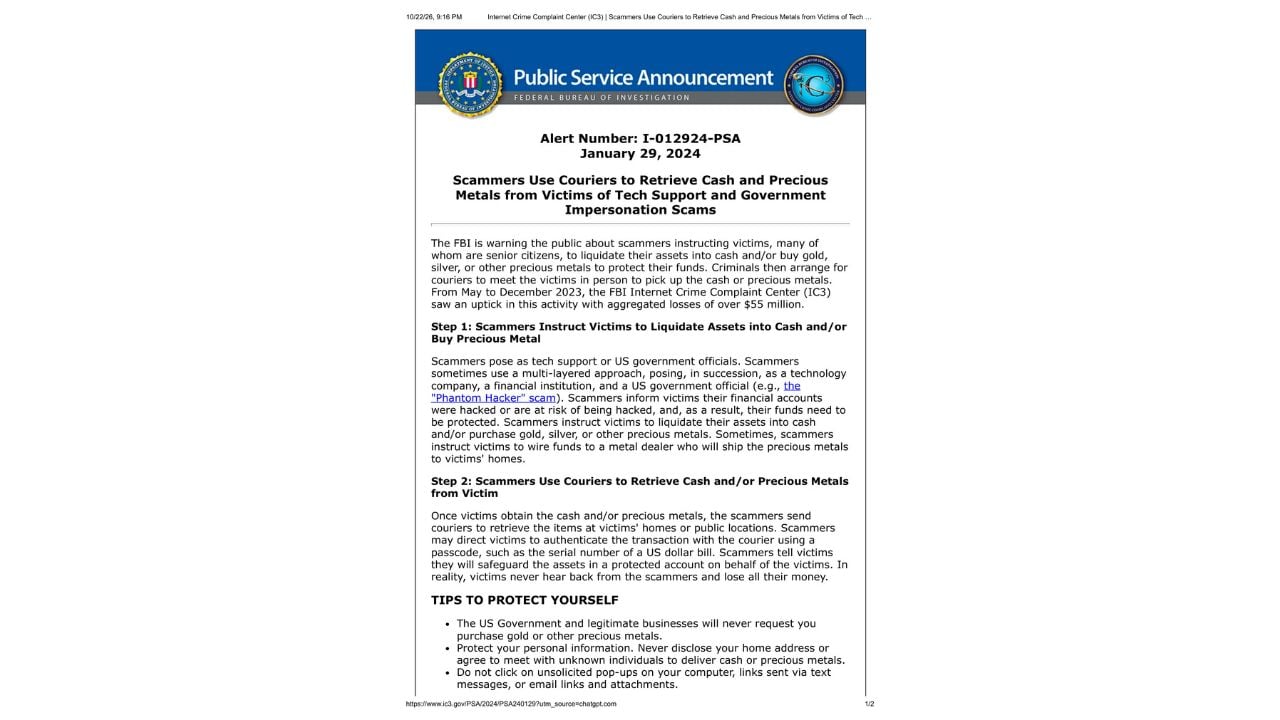
A January 2024 FBI warning describes scammers impersonating technology companies, banks or government agencies and claiming victims need to liquidate savings to keep their money secure. Couriers then collect cash or precious metals from victims’ homes or public meeting places.
In a September 2025 alert, the FBI reported at least 1,737 incidents nationwide involving couriers collecting cash or gold from 2023 through May 2025. Reported losses totaled approximately $186.3 million.
The agency said some schemes use a secret code, password or dollar-bill serial number to persuade victims that the person collecting the valuables is authorized. Such details can make a handoff appear official even though the underlying instructions come from impostors.
Other Investigations Show How Gold Couriers Are Used
In a separate Illinois case, a 78-year-old Marion woman handed over gold worth $318,459 to someone posing as a Treasury Department representative. After she noticed what appeared to be a faulty government seal, investigators arranged another collection using sandbags in place of gold. Police arrested Ruoyu Lian during the July 7, 2026 exchange. He pleaded guilty in September, according to Capitol News Illinois.
Another operation involved couriers and handlers working for overseas scammers. In March 2026, the Justice Department announced prison sentences for five people who helped collect and move gold from older victims in multiple states. Prosecutors estimated that the broader scheme took approximately $9.3 million, and one handler was ordered to pay $6.6 million in restitution.
What to Do if Someone Says You Must Move Your Savings for Safekeeping
The Social Security Administration warns that impersonators may threaten criminal charges, send official-looking documents, demand secrecy or insist that victims move money into protected accounts. No legitimate government investigator will require someone to buy gold bars or hand savings to a courier for safekeeping.
Anyone receiving such instructions should stop communicating with the caller and independently contact the agency or financial institution through its official website, app or statement. A claimed badge number, court document or reference code provided during the call should not be treated as independent verification.
Someone who has already sent a wire transfer or bought gold for a suspected scam should contact their bank and local police immediately. If a physical handoff is still planned, they should not attend it or confront the collector themselves. Preserve receipts, bank records, gold-dealer details, phone numbers, messages and any instructions used to arrange the collection.
The FBI asks victims to report suspected fraud through IC3.gov. Victims age 60 or older who need help filing a complaint can also contact the Department of Justice’s National Elder Fraud Hotline at 833-372-8311.