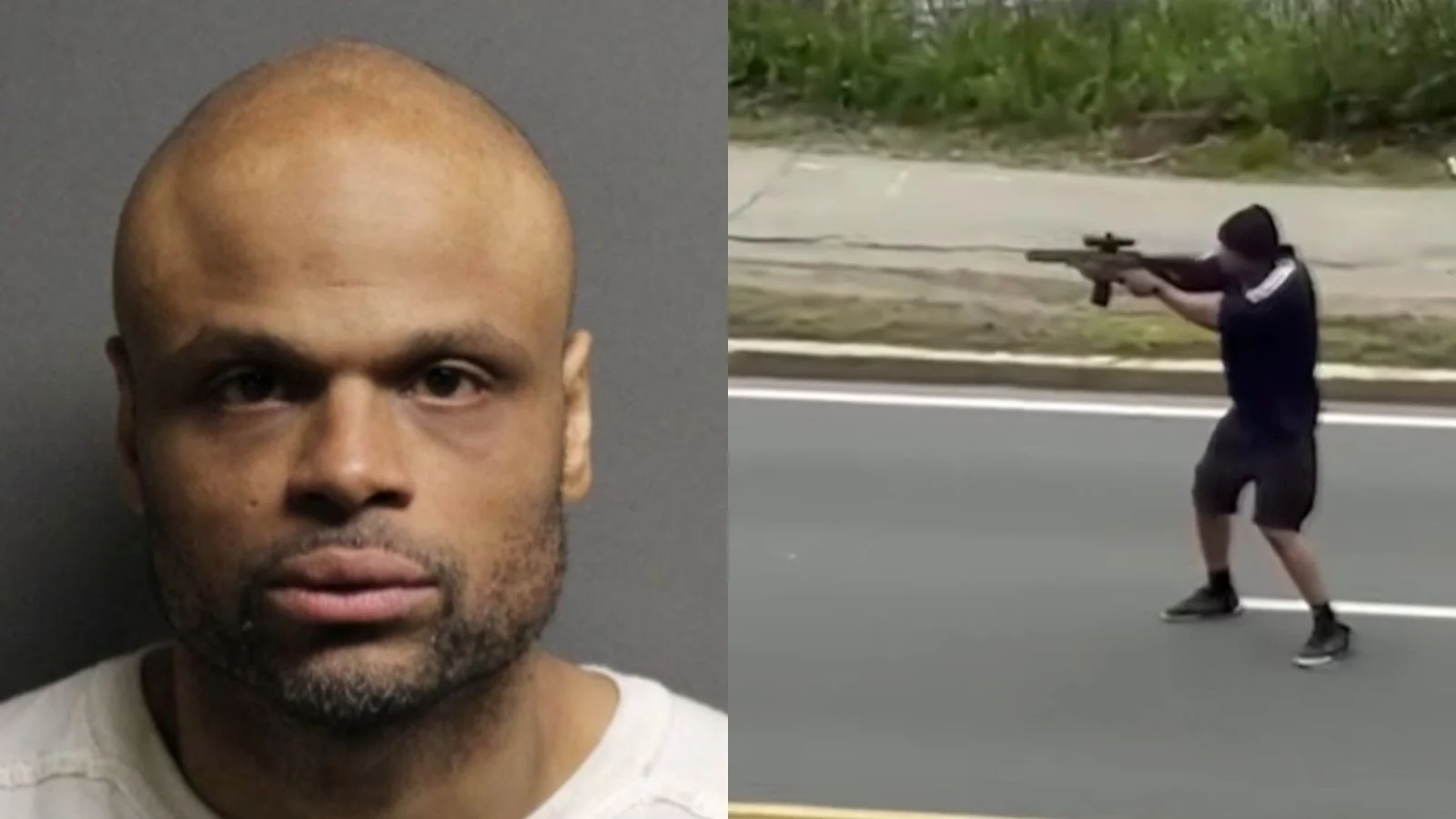
The two men shot on Memorial Drive in Cambridge on Monday afternoon have not been named publicly. They were hospitalized with life-threatening injuries. Prosecutors say they had no connection to Tyler Brown. He did not know them.
Brown, 46, is accused of walking along a road beside the Charles River, near Harvard and MIT, and firing more than 60 rounds at passing cars with an assault-style weapon. Drivers ran. Bullets hit at least a dozen vehicles. A state police cruiser was struck.
The people who stopped him were a Massachusetts state trooper and a former Marine who happened to be driving nearby with a pistol he was licensed to carry locked in a safe in his backseat. The Marine had been a firearms instructor. He retrieved the weapon and fired eight rounds. Both men moved toward the gunfire rather than away.
None of the people on Memorial Drive had any reason to prepare for Tyler Brown. A Boston police officer tried to warn a court in 2021 that someone would.
What the Court Heard in 2021
Brown’s criminal record spans years.
In 2014, he was convicted of assault and battery with a dangerous weapon and witness intimidation. While still on probation, he fired 13 rounds at Boston police officers in the South End in 2020. No one was hit. The officers returned fire. Brown later pleaded guilty to charges tied to that shooting.
At his 2021 sentencing, prosecutors from then-District Attorney Rachael Rollins’s office asked for 10 to 12 years. A Boston police officer involved in the 2020 attack wrote in a victim impact statement: “I am a firm believer that when Mr. Tyler Brown gets out, he will hurt, or worse, kill someone.”
Judge Janet Sanders sentenced Brown to five to six years.
Rollins criticized the sentence at the time. After Monday’s shooting, the Boston Police Patrolmen’s Association called it a “ball drop” and said the leniency shown to Brown was “the definition of insanity.”
Seventy-Three Minutes Before the Shooting
Brown was released from prison in May 2025 to serve the remainder of his sentence under parole supervision.
On Friday, May 8, according to court paperwork, he was released from an admission to McLean psychiatric hospital. He had previously been diagnosed with post-traumatic stress disorder, anxiety and depression.
On Monday, at 12:08 p.m., his parole officer reached him by phone and could tell something was wrong. Brown was expressing suicidal ideation, so the officer called 911 and his supervisor, then started driving to Brown’s residence.
When the officer arrived, Brown was not there. Brown then called on FaceTime from another number. The parole officer saw him waving a semi-automatic rifle inside a kitchen. Brown allegedly said he had relapsed. He said he was “not going back to prison.” He said “these people are gonna f—ing pay.” He claimed he had committed murders in the past and had not been caught. He later said he was no longer Tyler Brown and was now using his “shooter name.”
Police obtained warrants to locate his phone. By 1:21 p.m., it pinged near Kelly Road and Pleasant Street in Cambridge. The first shots were reported at 808 Memorial Drive around 1:30 p.m.
The Gaps Nobody Has Filled
Tyler Brown is a convicted felon. Federal law generally bars convicted felons from possessing firearms. Court records now charge him with carrying a firearm without a license and possessing a large-capacity firearm. They do not explain how he got the rifle.
That is not a small gap. Brown was on parole. He had a violent gun record. A parole officer allegedly saw him with a rifle more than an hour before the shooting. The public still does not know where the weapon came from or whether anyone else could face scrutiny over it.
The hospital question is also open. Who decided Brown was ready to leave McLean on Friday? What risk factors were evaluated? What, if anything, was communicated to parole officials? Those questions do not make mental illness the explanation for violence. Most people with mental illness are not violent. But when a person recently discharged from psychiatric care allegedly appears on FaceTime with a rifle and then opens fire on strangers, the timeline deserves examination.
The Sentence Nobody Can Ignore Now
Five years ago, a Boston police officer warned the court what Brown might do after release.
On Monday, two men were taken to a hospital with life-threatening injuries after being shot while sitting in cars on Memorial Drive. They had no connection to Tyler Brown.
The officer’s sentence now reads less like a warning and more like a document someone should have taken more seriously.
The question is whether anyone will be asked why they didn’t.