BEIJING — China again signaled that Taiwan would be a priority topic ahead of a highly anticipated summit between U.S. President Donald Trump and Chinese President Xi Jinping next week, saying that U.S. must adhere to the “one China principle” for a stable relationship with Beijing.
Last week, China’s top diplomat Wang Yi said he hopes the U.S. would make the “right choices” relating to the self-ruled island when he spoke with U.S. Secretary of State Marco Rubio.
China claims Taiwan as its own territory and has not excluded the use of force to take it. Beijing has been ramping up its military pressure by sending warplanes and naval vessels around the island almost daily.
“The Taiwan question is at the core of China’s core interests and the bedrock of the political foundation of China-U.S. relations,” said Foreign Ministry spokesman Lin Jian Thursday.
“Abiding by the One China principle and the three China-US joint communiqués and honoring the commitments made by U.S administrations on the Taiwan question, is the due international obligation of the United States and the prerequisite for a steady, sound, and sustainable China-U.S. relationship,” he added.
Such strong language so close in time to the two leaders’ meeting is rare for Beijing, said Arthur Zhin-Sheng Wang, a defense expert at Taiwan’s Central Police University. The new language also explicitly links U.S. diplomatic actions on Taiwan to Washington’s relationship with China.
China and Taiwan split after a civil war in 1949. The U.S. is the island’s largest unofficial ally and also sells weapons to Taiwan as part of a law which requires it to ensure Taiwan can defend itself. Those weapons sales and diplomatic support is a primary source of tension between China and the U.S.
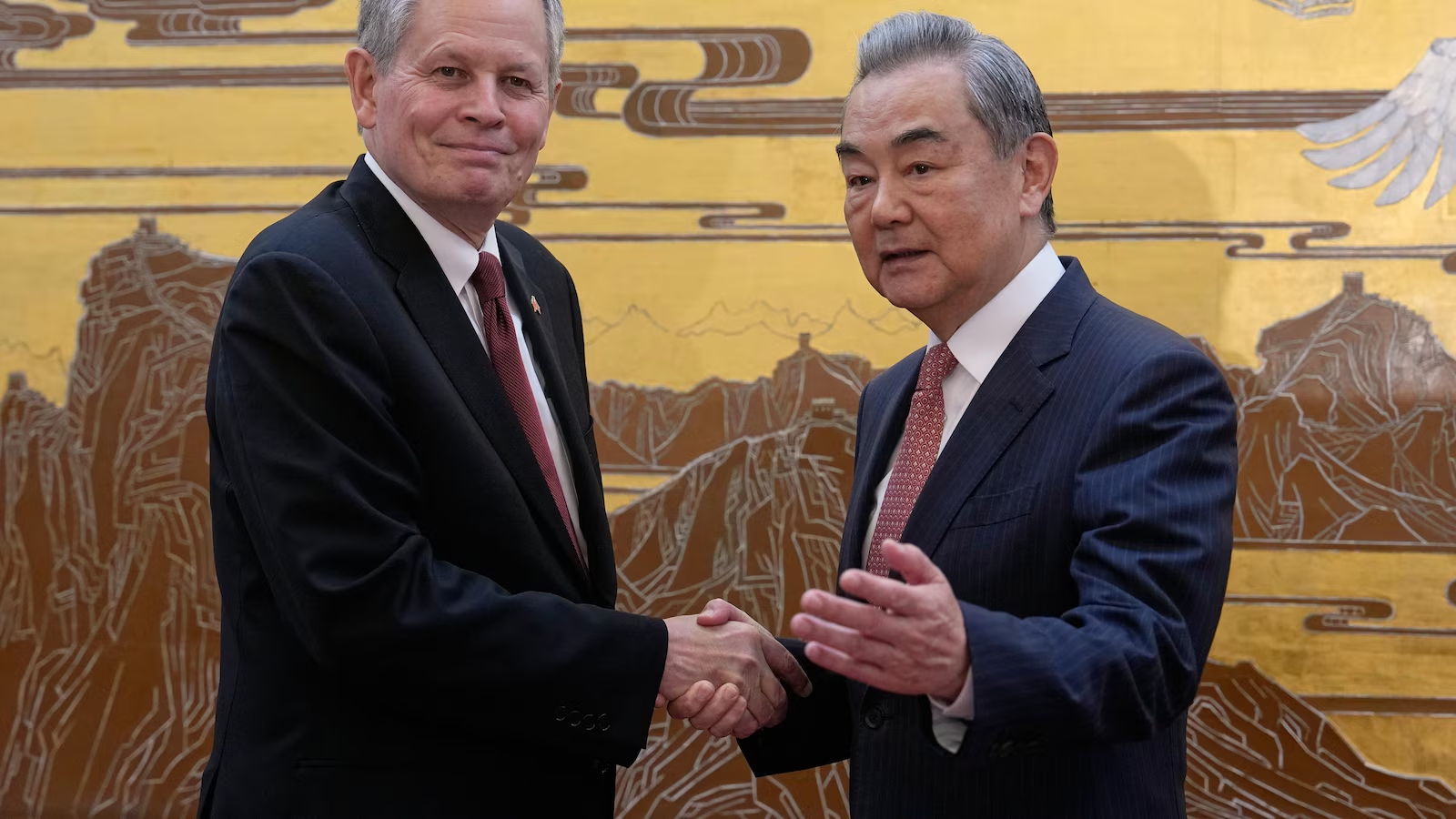
Separately, China’s top diplomat Wang said Thursday in a meeting with visiting American senators that ties with both sides have managed to keep things stable amid disruptions.
During a meeting with members of a U.S. bipartisan congressional delegation, led by Sen. Steve Daines, Chinese Foreign Minister Wang Yi credited Presidents Xi Jinping and Trump for “helping steer the direction of bilateral relations at critical moments.”
“Over the past year, China-U.S. relations have gone through many twists and disruptions, but we have still managed to maintain overall stability,” Wang said.
Daines, a member of the Senate Foreign Relations Committee and a strong supporter of Trump, agreed and said that both countries should look for stability.
“I strongly believe that we want to de-escalate, not decouple. We want stability, we want mutual respect,” he said.
Daines hinted at one possible outcome to the two leaders’ meeting next week, saying, “perhaps we could see some more Boeing airplanes purchased, which I know would be something we would like to see.”
The senator also recognized China’s efforts to help reduce tensions in the Middle East and reopen the Strait of Hormuz. He said that Wang’s meeting on Wednesday with the Iranian Foreign Minister Abbas Araghchi was proof of China’s engagement.
Ahead of Trump’s visit to China, scheduled for May 14-15, the U.S. government has been pressing Beijing to use its influence with Iran to reopen the Strait of Hormuz, where 20% of the world’s oil normally flows.
It was Daines’ second trip to China since Trump took office last year. He previously visited in March 2025, when the two countries were locked in frictions over trade tariffs and efforts to combat illegal fentanyl trade.
—-
Wu reported from Bangkok.