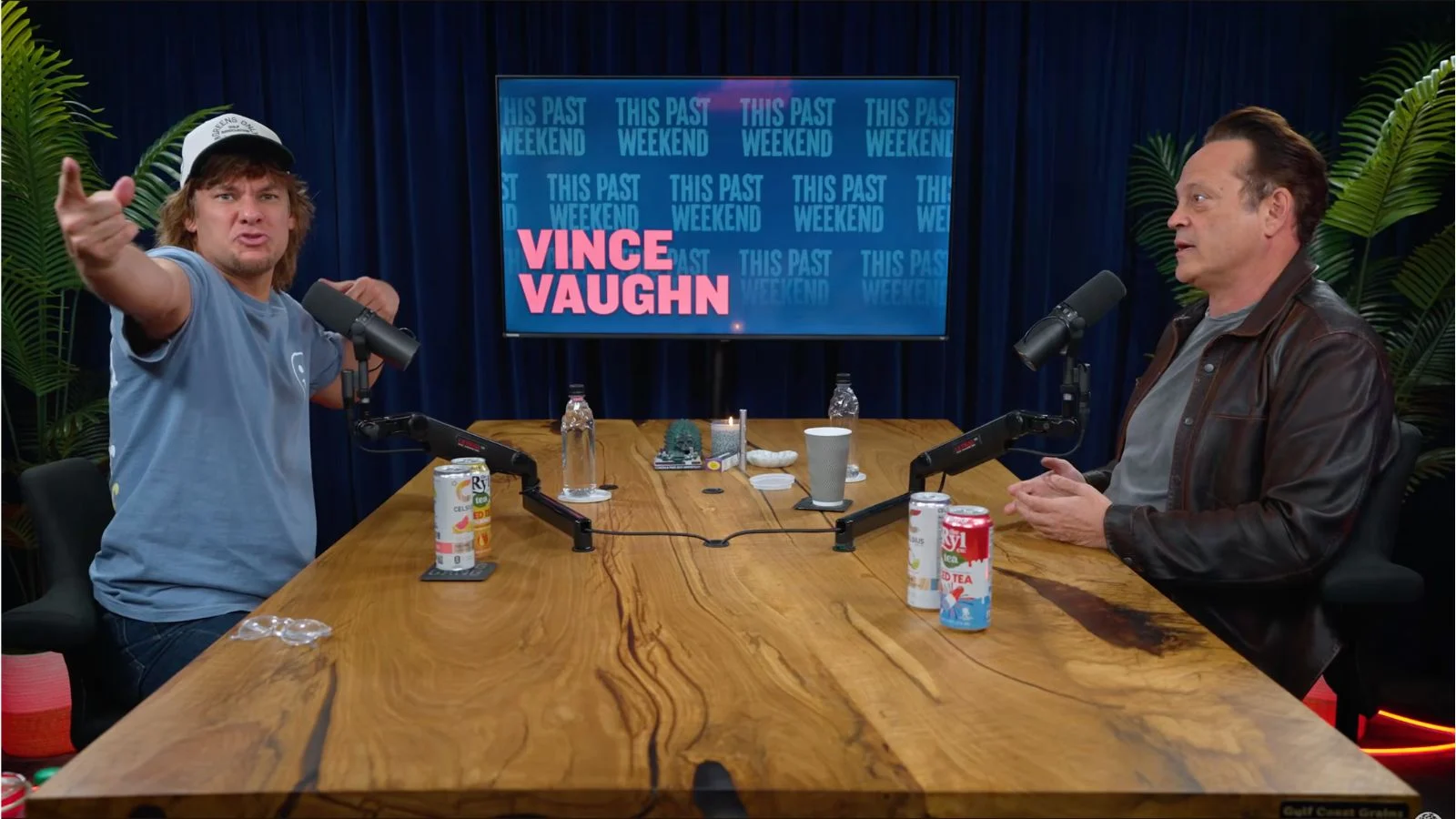
Vince Vaughn sat across from Theo Von on Tuesday and did something unusual for a working actor with a movie to promote. He told the truth about the industry’s most protected format.
“It stopped being funny, and it started feeling like I was in a f—ing class I didn’t want to take,” Vaughn said on Von’s This Past Weekend podcast. “I’m getting scolded.”
He called the shows “agenda-based.” He said every host became the same host. He compared the experience of watching late-night to being trapped next to someone on a plane you can’t escape. Von — whose podcast is the fourth-biggest on Spotify globally — added that late-night hosts narrowed their targets until the only people left to mock were “white redneck kind of people,” and that ratings tanked accordingly.
The question isn’t whether Vaughn has a point. The question is whether he has the whole picture.
Actor Vince Vaughn calls out late-night comedians, says people like Jimmy Kimmel, Stephen Colbert, and others have all become the “SAME SHOW.”
“It stopped being funny, and it started feeling like I was in a f*cking class I didn’t want to take.”
THEO VON: “A lot of the late… pic.twitter.com/9gTyBfdWtc
— The Vigilant Fox 🦊 (@VigilantFox) March 24, 2026
What the Numbers Say
The decline is not subtle. Every major late-night host has lost the majority of their audience since 2015 — Kimmel, Colbert, and Meyers each saw viewership collapse by roughly 70 to 80 percent. Fallon’s Tonight Show — once the franchise that defined NBC — shed 51 percent of its viewers in six years. Combined 18-49 viewership across all of late-night dropped 17 percent in a single year. Colbert’s show reportedly bled between $40 and $50 million in 2024 alone.
Then the dominoes started falling. CBS cancelled Colbert last July and went a step further — it retired the Late Show name entirely, ending a franchise that had been on the air since David Letterman arrived in 1993. The finale airs May 21. Critics called it political censorship. Colbert himself called a Paramount settlement with Trump “a big fat bribe” days before the announcement. But a show hemorrhaging $40 to $50 million a year doesn’t need a political explanation to get cancelled. Sometimes the math is the story.
What Vaughn Gets Right — and What He Skips

Vaughn’s explanation is clean: the shows got preachy, audiences left, end of story. “They always blame technology,” he said. “But the reality is the approach.”
It’s a satisfying diagnosis. It’s also incomplete.
Late-night airs at 11:35 PM on linear broadcast TV — a medium that has been losing viewers across every format for a decade. A 23-year-old isn’t choosing between Kimmel and Theo Von. They’re not watching broadcast television at all. Meanwhile, 584 million people worldwide now listen to podcasts. In the U.S., 55 percent of the population tunes in monthly — the first time that number has ever crossed the majority line.
But here’s where Vaughn’s argument earns itself back. Late-night did go digital. Kimmel, Fallon, and Colbert all post clips to YouTube, pulling millions of views. They live on the same platforms as podcasts. And they’re still losing to shows with no writers’ room, no set, and no budget. As one CBS insider told The Wrap last year: “YouTube is digital dimes versus network dollars.”
So the delivery system is dying, yes. But the shows that adapted to the new one are still getting outrun by two guys in a room with microphones. That part can’t be explained by cord-cutting alone.
Where Vaughn Stands
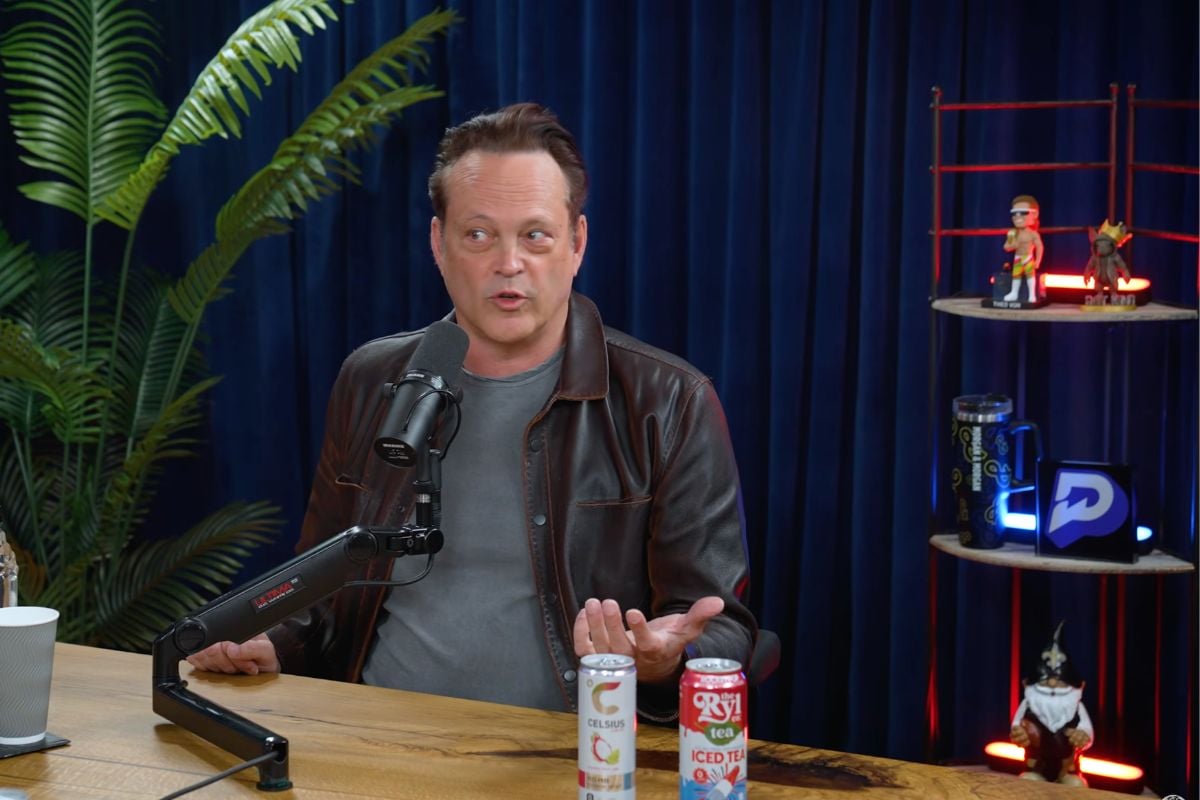
Vaughn hasn’t appeared on Kimmel’s show since 2015. He’s never been on Colbert’s. He visited Trump at the White House last April. He calls himself a libertarian. The Daily Beast called him MAGA.
None of that makes him wrong. But he’s not a neutral bystander watching the building burn from across the street. He’s someone who walked out of the building years ago and is now explaining the fire.
The building is burning, though. Colbert’s show ends in two months. Kimmel has hinted at retirement. NBC already cut Meyers’ band and trimmed Fallon’s schedule.
And Vaughn delivered his eulogy for late-night on a podcast with no network, no time slot, and no teleprompter — to an audience that keeps growing while the rooms he’s describing keep emptying.