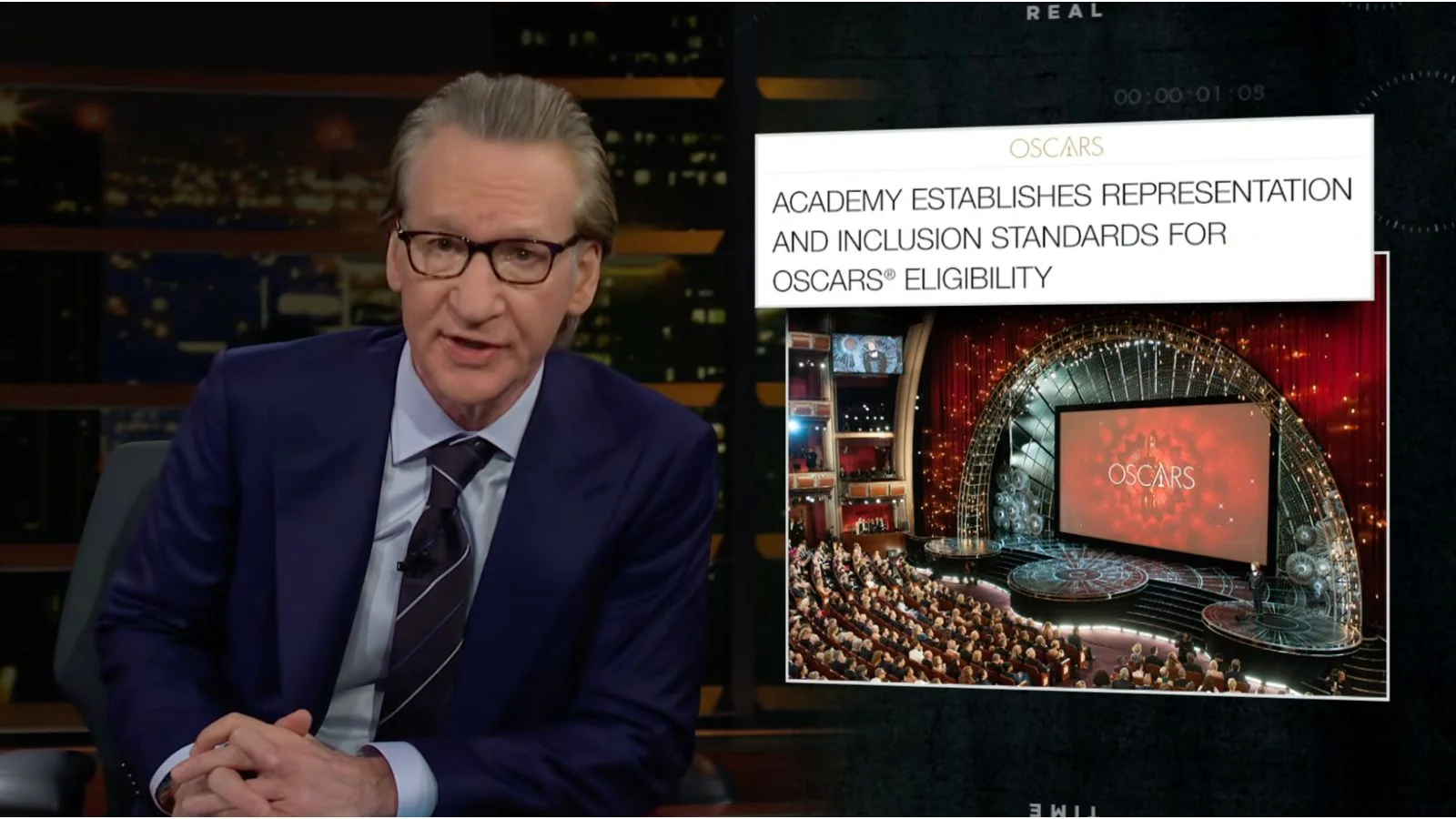
Bill Maher spent the first half of his Friday night monologue telling progressives to stop complaining about the Oscars. He spent the second half explaining why nobody should trust the Oscars about anything.
On the March 13 episode of Real Time, one night before the 98th Academy Awards, Maher devoted his closing “New Rule” segment to the 10th anniversary of #OscarsSoWhite — the campaign that launched a decade of diversity scrutiny aimed at the Academy. His argument was simple: it worked. Move on.
The victory lap
Maher rattled off the receipts. Best Picture in the last decade has gone to Everything Everywhere All at Once, Parasite, CODA, Moonlight, and The Shape of Water. Acting Oscars have gone to Will Smith, Michelle Yeoh, Ke Huy Quan, Da’Vine Joy Randolph, and Mahershala Ali — twice. Eight of the last 10 Best Director prizes went to filmmakers from underrepresented groups. So did 60 percent of the honorary awards.
He told the room that nobody could argue, “with a straight face — or even a gay face,” that the Academy in 2026 still overlooks minority achievement. He called Hollywood “a secret cabal of people terrified of looking like racists.” And he said he was tired of “social justice warriors feeling the need to gaslight us as if none of it had happened.”
Then he went after the Academy’s inclusion requirements for Best Picture eligibility — the rules mandating that a certain percentage of crew or department heads come from underrepresented groups. Maher argued that under those standards, films like Titanic, Braveheart, and Amadeus couldn’t even be considered today. Apollo 13, he noted, “was about a bunch of white people because white people have done some stuff” — but Hidden Figures got made anyway, without a rulebook forcing it into existence.
Then he pointed to this year’s biggest contender to make his case: Sinners, Ryan Coogler’s supernatural thriller, which earned a record 16 Oscar nominations. Maher’s verdict: “It doesn’t need affirmative action.”
That was the argument. Diversity won. The rules are overkill. Trust the system.
Then Maher stopped trusting the system
What followed was a five-minute dismantling of the institution he had just told everyone to believe in.
Maher proposed a new hashtag — #OscarsSoWrong — and proceeded to list every Best Picture winner that history has quietly overruled. Citizen Kane lost to How Green Was My Valley. Saving Private Ryan lost to Shakespeare in Love. The Shawshank Redemption lost to Forrest Gump. Raging Bull, Pulp Fiction, 12 Angry Men, Singin’ in the Rain, Dr. Strangelove — none of them won.
He didn’t stop at the films. He went after the acting awards with a taxonomy of Oscar biases that have nothing to do with performance. Play a real person — Gandhi, Lincoln, Ray Charles, Harvey Milk — and the award is yours before the credits roll. Portray a physical or mental disability — blind, deaf, ALS, cerebral palsy — and the Academy “should wear a hospital gown.” Gain or lose dramatic weight, or wear a prosthetic nose, and the statue practically engraves itself.
Then there’s what Maher called “the Grandpa’s Last Christmas Award” — the prize that goes to an actor the Academy suspects won’t be nominated again. Art Carney in Harry and Tonto beat Jack Nicholson in Chinatown. John Wayne in True Grit got the same treatment. And Al Pacino went unrewarded through The Godfather, Serpico, Dog Day Afternoon, and Scarface — then won for playing a blind man who screams “hoo-ha.”
He called the Academy “a room full of know-nothings” whose judgment “is often terrible and fails the test of time.”
The math that Maher didn’t do

The two halves of the monologue don’t sit comfortably next to each other.
In the first half, Maher argued that the Academy’s diversity record proves the system works — that the right people are getting recognized, and the rules mandating inclusion are unnecessary overcorrections. In the second half, he argued that the Academy has been catastrophically wrong about almost everything for the better part of a century.
Both arguments drew applause. Neither seemed to notice the other.
Sinners walks into tomorrow’s ceremony with 16 nominations, a potential Best Picture win, and the possibility of making Ryan Coogler the first Black filmmaker to win Best Director. Maher held it up as proof that the Academy doesn’t need diversity rules to recognize excellence. Then he spent five minutes explaining that the Academy routinely fails to recognize excellence — rules or not.
The 98th Academy Awards air Sunday, March 15 at 7 p.m. ET on ABC and streaming on Hulu.