The head of the Centers for Disease Control and Prevention’s vaccine advisory committee questioned whether broad recommendations are necessary for vaccines that protect against polio and other infectious diseases.
Dr. Kirk Milhoan, a pediatric cardiologist who was appointed chair of the CDC’s Advisory Committee on Immunization Practices (ACIP) by Health Secretary Robert F. Kennedy Jr. last month, said decisions on whether to receive a vaccine should be made by patients and doctors, not by mandate.
“We were concerned about mandates, and mandates have really harmed and increased hesitancy,” Milhoan said. “Does it [need] to be mandated for you to go to kindergarten, that these kids have every one of these vaccines that are recommended? That should be individually based. That is what I do as a doctor.”
Milhoan made the comments while appearing on the podcast “Why Should I Trust You?” hosted by ABC News medical contributor and investigative reporter Dr. Mark Abdelmalek, Tom Johnson and Brinda Adhikari.
Vaccines such as the polio and measles vaccines have been hailed by public health officials as immense successes, preventing serious disease and death among millions worldwide. Both wild poliovirus and measles were eliminated in the U.S. decades ago due to mass vaccination campaigns.
However, during the wide-ranging and candid interview, Milhoan said the ACIP is concerned with “returning individual autonomy” to restore trust in public health.
Milhoan questioned if Americans need to receive the polio vaccine anymore, arguing that the U.S. is in a different place compared to the 1950s, when the first polio vaccine was distributed.

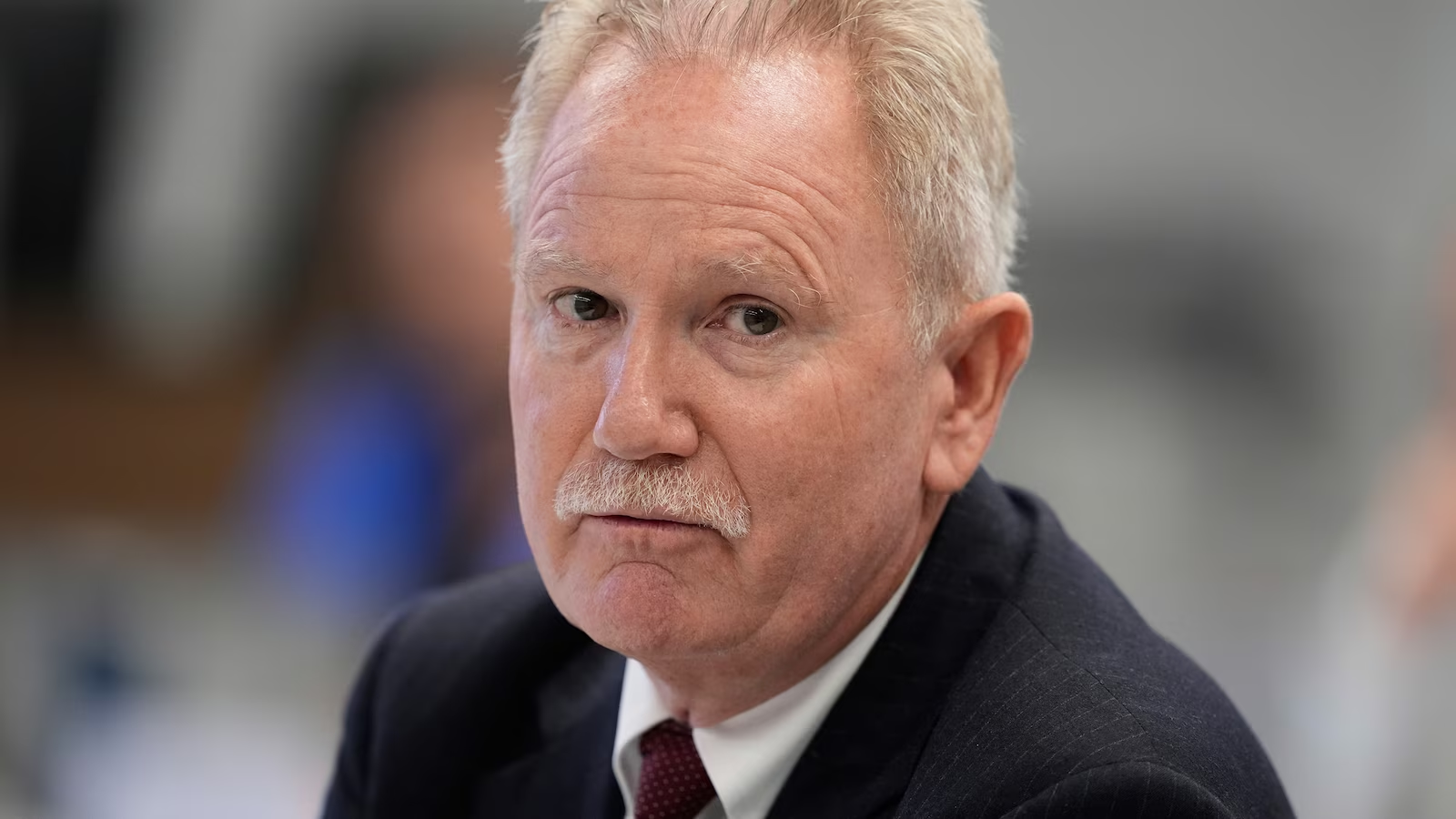
Committee member, Dr. Kirk Milhoan, speaks during a meeting of the Advisory Committee on Immunization Practices at the CDC, Sept. 18, 2025, in Chamblee, Ga.
Brynn Anderson/AP
Currently, the CDC recommends that children receive four doses of the polio vaccine: at two months old, four months old, six to 18 months old and a booster between ages 4 and 6. Every U.S. state requires children to be vaccinated against polio to attend public schools.
“As you look at polio, we need to not be afraid to consider that we are in a different time now than we were then,” Milhoan said. “Our sanitation is different, our risk of disease is different, and so those all play into the evaluation of whether this is worthwhile of taking a risk for a vaccine or not.”
He continued, “We have to take into account that, are we enjoying herd immunity right now, that it may look like it’s better not to get a vaccine than to get a vaccine, but if we take away all the herd immunity, does that switch?”
Milhoan’s comments received criticism from large medical organizations, such as the American Medical Association, and medical professionals, including Dr. Paul Offit, director of the Vaccine Education Center and an attending physician in the division of infectious diseases at Children’s Hospital of Philadelphia.
Offit described Milhoan’s comments as “frightening,” adding that the ACIP chair expressed several ideas that are “directly averse to the health of children in this country.”
He also said that many of Milhoan’s comments are incorrect, including statements about polio.
Offit explained that although the incidence of measles and whooping cough partly decreased due to improved sanitation, the opposite was true with polio. In the case of polio, improved sanitation increased the age at which a child was first exposed to polio — after antibodies passed down from the mother wore off — which made them more susceptible to paralysis.
Offit said it seems to him that Milhoan doesn’t know that improved sanitation increased cases of severe polio.
“A lot of people don’t know, but what upsets me is that he’s in a position … where he should know it,” Offit said.
Milhoan also questioned the need for the measles, mumps and rubella (MMR) vaccine, which is also recommended by the CDC for children and required by every U.S. state to attend public schools. Last year, the U.S. saw the highest number of measles cases in 33 years with 2,255 infections, according to CDC data.
He argued that measles cases were declining before the advent of the vaccine and that hospitals are better equipped to take care of measles patients today.

Dr. Neville Anderson, left, helps to hold Iris Behnam, 4, while nurse Breanna Kirby, right, gives her DTap Polio and MMR Chickenpox (Varicilla) vaccinations while her mom, Haley Behnam, holds and comforts her at Larchmont Pediatrics in Los Angeles, March 25, 2025.
Allen J. Schaben/Los Angeles Times via Getty Images
“We take care of children much differently now,” Milhoan said. “Our ability to have pediatric hospitals, children’s hospitals, pediatric ICUs, how we look at the whole gamut of how we can treat measles is different. So that’s something that comes into play.”
Offit said it’s not true that doctors have gotten better at treating measles among children who are hospitalized. No treatments have been developed in the last six decades, after the first measles vaccine became available.
“We’re no better at treating measles than we were 60 years ago,” Offit said. “I mean, what do we have? We have oxygen, we have ventilation. We had that in the 1960s. And in terms of dehydration, we had intravenous fluids. Again, no difference.”
Offit also said that since the measles vaccine was developed, the death rate hasn’t changed. Currently, one to three out of every 1,000 children with measles will die from respiratory and neurologic complications.
Last year, the U.S. also saw its first measles deaths in more than a decade, including two among unvaccinated school-aged children in Texas and one among an unvaccinated adult in New Mexico.
“The mortality rate of measles before the measles vaccine was one to three per thousand [children],” Offit said. “We’ve had three people die, two of whom were children, this past year, among, let’s say, 2,100 people who had measles. That’s the same mortality rate as we had before there was a measles vaccine. So, what’s [Milhoan] talking about?”
Co-host Dr. Mark Abdemalek pressed Milhoan during the podcast about the adverse risks of measles infection being worse than risks from the MMR vaccine and brought up the same one in three mortality figure.
“This is not current data,” Milhoan replied.
Co-host Tom Johnson asked Milhoan about his philosophy on individual autonomy with the example of a parent who chooses not to get their child vaccinated against measles and that child subsequently infects a different immunocompromised child. Johnson asked Milhoan if there is a line to cross where individual autonomy infringes on another child’s safety.
“I would say I agree, there are two different things at play here. We don’t take one over the other,” Milhoan said. “Let’s just flip that the other way around. What if the child gets a measles vaccine to protect your immunocompromised child and gets a negative consequence from that? Wasn’t that your child causing that child to be harmed?”
When asked directly whether vaccines are adequately studied for safety, Milhoan said they are not, arguing that research has focused primarily on efficacy.
He dismissed the surveillance and monitoring systems as “very poor,” signaling deep skepticism about the current infrastructure used to detect and evaluate vaccine safety signals.
Offit said the comment that concerned him the most was when Milhoan was told by one of the hosts that ACIP would probably be receiving reports, files and data on vaccines to review based on established science, to which Milhoan replied, “That’s not science.”
“Science is what I observe,” he added.

The MMR vaccine at the City of Lubbock Health Department in Lubbock, Texas, Feb. 27, 2025.
Annie Rice/Reuters, FILE
In response to perceived attacks from news organizations following the podcast, the Independent Medical Alliance, a group that promoted unproven treatments during the COVID-19 pandemic, defended Milhoan.
“Dr. Milhoan is an accomplished pediatric cardiologist and former U.S. Air Force physician who believes the Constitution protects citizens from government intrusion into personal medical decisions,” the statement read, in part.
“To be clear, Dr. Milhoan is not anti-vaccine. He does not deny the success of the polio or smallpox vaccines. He is not calling for bans, rollbacks, or mass refusals. He is simply saying something far more dangerous to centralized power: that patients should decide, in consultation with their doctors,” the statement continued.